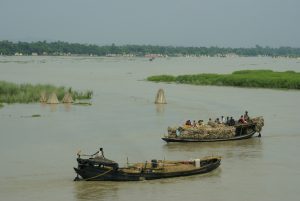
![<p>Inland waterways could revolutionise trade in South Asia [image by fr4dd/Flickr]</p>](https://dialogue.earth/content/uploads/2016/09/water-transport-768x512.jpg)

Too often over the last half century, transboundary water meetings have been rather dismal, zero-sum games primarily because the underlying ethos has been allocation of scarce dry season flow, primarily for supplemental monsoon irrigation through diversion barrages in the Kosi, Gandak, Sarda, Teesta and many other Himalayan rivers.
Such meetings are bound to be rife with suspicions because what one gets, the other automatically won’t. Attempts to shift to increasing the dry season flow in the rivers by building reservoirs that store the monsoon rains went nowhere primarily because of the inability of Nepali hydrocrats to see any beneficial use other than hydropower and Mughlani ones acting too-smart-by-half, playing along Nepali egos and discussing only hydropower while hoping to become free-rider beneficiaries of flood control, irrigation etc. from regulated reservoir flows.
The Nepali public was much too smart to be fooled by this: public opinion made it politically suicidal for politicians to agree to drown Nepal’s highland villages and fertile land under reservoirs so that those in Uttar Pradesh and Bihar would get free irrigation and flood control. Bangladesh’s plea for more river flow went nowhere as the first and only trilateral meeting between Nepal, India and Bangladesh in 1986 (at which this writer was responsible for preparing the minutes), too ended in a failure.This highland-lowland conundrum plagues India internally too, whether it has to do with Arunachal and Meghalaya in the east or Uttarakhand in the west who don’t like the idea of drowning their hill villages to provide free water for the development of the plains.
The Shillong meeting saw the participation of several chief ministers of Indian North-Eastern states, a 148-member Bangladesh delegation led by two ministers, Bhutan’s led by the redoubtable former home minister Dago Tshering as well as a delegation from Myanmar. Although issues such as tourism and trade were discussed, the primary agenda ended up becoming the pressing need to revive riverine transport: it seems during the British rule, goods from abroad came up from the Bay of Bengal along the Brahmaputra all the way up to Tejpur and Dibrugarh. The same was true of the Ganga deep into United Provinces (now Uttar Pradesh). However, this cheap and ecologically sensible means of transport was slowly smothered post-Independence by truck and railway interests.
The interest in reviving inland navigation was happening against the backdrop of the Indian Rajya Sabha (the upper house of parliament) approving the National Waterways Bill in March 2016 to convert 111 rivers in India into waterways.
See also: India plans to overhaul rivers for shipping
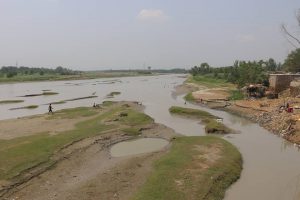
While the Ganga had been declared a waterway till Allahabad as early as 1986, nothing much had happened to push this idea forward since a major problem is the low flow period when the depth of the river decreases and sandbars do not allow easy barge transport. Unless the dry season flow is augmented, the required depth in the river cannot be maintained; and to do so one has to either build monsoon water storing reservoirs (which would increase the dry season flow by ten to twenty times for an average high dam, and thus corresponding river depth) or severely curtail groundwater pumping in the Ganga plains. Indeed, in the upper reaches of the Indo-Gangatic plains, both the Yamuna in Delhi and the Ganga at Kanpur carry little water and mostly sewerage backflow. The only positive trend was in Bangladesh where the revival and modernisation of country boats have become fashionable.
The economic case
The case for inland navigation for regional development is quite compelling. First, no major continental-sized region of the world has developed economically without developing inland riverine transport. The Rhine is navigable all the way from the North Sea and Rotterdam to land-locked Switzerland, the Mississippi from the Gulf of Mexico to the Great Lakes and Canada, the Volga-Don river system from the Black Sea to the Baltic, and the Danube from the Black Sea to the inner heartland of Germany, and indeed via the Rhine link all the way to Rotterdam. China began to earnestly restore its inland waterways in 1984 after her road and rail system started to be congested with fast economic growth; and today she enjoys the same commercially significant length of navigable inland waterways as the US and EU combined.
The regional imperative to develop inland riverine transport stems from overall energy economics and efficiency (how much weight of cargo one horsepower engine can move). It is 150kg for trucks on road, 500kg for railway and 4,000kg for inland water transport! In terms of energy, inland shipping consumes 230 mega joules/1000 tonne-km while rail transport consumes double that (430) and truck a further double of that (920). When one calculates the savings in the transport of bulk goods such as coal, grains, iron ore, construction material etc. over an entire regions such as the Ganga or the Brahmaputra basin, even rough ball park figures can be immense and mind-boggling.
Unless a region such as South Asia can take advantage of such energy (and hence cost) efficiencies, competitive economic growth will only be pipe dream. India does less than 4% of its trade via this economically efficient transport mode of inland waterways: in China by contrast the figure is 47%, and the global consequences are obvious – one is an actual power house of economic growth, the other is primarily bombast with still the largest number of poor people in the world.
The environmental case
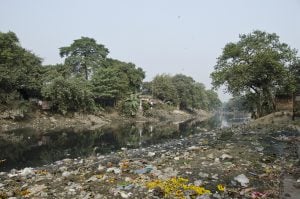
The second compelling reason is environmental: the current policy of South Asian hydrocrats is “not to let a single drop go waste to the sea”, meaning sucking the river dry and filling it with sewerage backflow. Bringing navigation onto the policy front burner means two things: at least a decent amount of water has to be there in the river and it has also to be relatively clean lest the bargemen choke and die from methane and carbon monoxide poisoning and ships and barges corrode rapidly. What South Asia currently badly needs is an environmental movement that sees the alliance of environmentalists keen to clean up the rivers and a consumer lobby that wants to see the price of products reduced. It is a movement waiting to be born.`
The third compelling reason is transboundary water politics. Major storage projects in the Ganga-Brahmaputra basins have stalled these last six decades primarily because the highlanders do not see much benefit in drowning their villages to build those reservoirs. If Nepal, Bhutan and the Indian states of Sikkim, Arunachal, Meghalaya, Mizoram or Uttarakhand can see that containers from Europe or Japan can come to their doorsteps at Chatra or Chisapani and similar places elsewhere – and they could benefit from reduction in the cost of their goods – there would be that much more reason for them to agree to building the Kosi, Karnali, Pancheswar and other water storage facilities that would also provide flood control, electricity and other multipurpose side benefits. Indeed, the backwardness of UP, Bihar, Nepal and the Indian North-East can be traced to their land-lockedness made worse by the Marxist trade union controlled Calcutta port and the extortionist policies that hold sway there.
India’s passing of the National Waterways Act for 111 of its large and small rivers is a landmark game-changer provided it is followed up with significant political will. A start in this direction was made in 1997 when Nepal’s doyen among her hydro-technical engineers, Dr Ananda Bahadur Thapa, led the negotiations on the Kosi High Dam project. He was able to get the agreement to include inland navigation as part of the framing of this mega project; but almost two decades have since passed without much progress on this front. South Asia is still waiting for leaders who can re-think its regional economy in broader global and strategic terms.
This article first appeared at New Spotlight News Magazine.