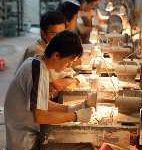
China’s impressive economic development has come at the expense of increased environmental impacts. China overtook the United States in 2007 to become the world’s largest emitter of carbon dioxide, decades sooner than scientists were predicting only a few years earlier.
A significant share of China’s emissions growth is due to production for export. One-third of China’s emissions in 2005 were due to exported products, up from 16% in 1990. In the last five years, over one-half of the growth in Chinese emissions was due to products for export. More than half of these were destined for developed nations, with one-quarter destined for the US. The bulk of this growth is due to manufactured products, such as electronics and textiles.
But this large share of exported emissions need not represent a problem for the global trading system. The issue, in fact, lies with China’s less carbon-efficient production system, and primarily with its electricity generation. In other words, if all of China’s electricity generation was renewable, then Chinese products would be good for the wallet and the climate.
The importance of exports in Chinese emissions suggests that international trade could play a key role in policy discussions toward an agreement to succeed the Kyoto Protocol in 2012. The challenge is to ensure that trade can be used to encourage China’s participation in post-2012 climate policy, not to discourage it.
China’s export growth results largely from its competitive pricing and large production capacity. This competitive advantage has been used to drive down the costs of manufactured products, with demand fueled by consumption in rich nations. Using similar principles, China can drive down costs of energy-efficient or renewable technologies. This could make China a powerhouse driving the global diffusion of new products and technologies needed for a low-carbon society, both globally and within China.
Solutions to Chinese emissions growth need to come from inside and outside China. Internally, China can stop bad choices that will linger in the system for decades: the country must ensure that new installations use the latest clean technologies and push the barriers of technological feasibility. The scale of China’s development presents a golden opportunity to experiment and go where rich nations currently lack courage, such as large-scale experimentation with carbon capture and storage. Removing subsides on fossil fuels and redirecting them to non-fossil resources could increase the uptake of renewable energy. Investing in urban planning and infrastructure that moves China off a fossil-fuelled future will significantly reduce future mitigation costs. These initiatives need not increase costs, but may shift money from those with vested interests to those with the ideas and concepts needed to transform the future.
Rich countries can take the first step by replacing rhetoric with solid examples. Policies in rich nations that aggressively encourage the installation of clean technologies must be matched by a means of production. Encouraging China to focus mass production of clean products, with consummate rewards, will drive down production costs and speed global diffusion of technologies such as solar panels and wind turbines.
Industrialised countries must also shift the demands on Chinese production from conspicuous consumable items to clean technologies. Rich nations can place strict efficiency requirements on the use of consumable products, thereby forcing Chinese producers to meet those standards to have a saleable product. Typical products would include household appliances or passenger vehicles. Similar policies already exist for other environmental issues, such as the European Union’s Waste Electrical and Electronic Equipment (WEEE) directive and Restriction of Hazardous Substances (RoHS) directive. Increased production will stimulate innovation and drive down production costs, aiding the global diffusion of low-cost energy efficient items, both inside and outside China.
These solutions aim to offer China an incentive to increase production and trade by shifting Chinese production towards clean technologies. To continually receive these benefits, China must agree to use a share of the proceeds to implement aggressive measures at cleaning its own production systems. Global sectoral approaches are one option to monitor China’s progress, but care must be taken not to burden the Chinese economy.
If a global agreement aims to encourage China to produce clean technologies then, at least in the short term, there may be an increase in Chinese emissions. This highlights a difficulty with the current focus on mitigating territorial emissions. Emissions from the Chinese economy that benefit consumption in rich countries, particularly conspicuous consumption, should not only be seen as a problem of Chinese production, but also a problem of global consumption. Likewise, countries that produce clean technologies or can produce products with less carbon emissions than other countries should be encouraged. Aluminum produced with electricity generated by hydropower, for example, should be encouraged over the use of coal power.
Emissions targets with timetables, as in the Kyoto Protocol, serve a useful objective in measuring progress and providing goals. However, for global pollution such as greenhouse gases, targets and timetables should not serve to shift the problem from one nation or sector to another. Targets and timetables currently focus on disconnected units – national territories – and fail to recognise the increasing interconnection of the global economy. Constraints on Chinese emissions need not act as a constraint on the nation’s economy or as a constraint on the country becoming a global leader in a low-carbon future.
China has the opportunity to become the global leader in low-carbon technology development and production. The future often seems grim when recent trends in Chinese emissions are considered, but China’s growth is young and rapid enough to allow for the rapid installation of tomorrow’s technologies, which will transform society. Today’s developing countries have the best opportunities to become low-carbon leaders. Rich nations suffer from deep-sunk costs and entrenched vested interests. China has the chance to step forward and revolutionise the world in a way that few thought possible.
Glen Peters is senior research fellow at the Center for International Climate and Environmental Research (CICERO), Oslo, Norway
Homepage photo by Ian Koh