A workshop in Stockholm, Sweden has explored the trade-offs of working with China on just transitions towards clean energy. “Global China and Just Transitions” was the fourth and final workshop in a series on China’s involvement across Latin America, Southeast Asia, Africa and Europe, organised by the Raoul Wallenberg Institute (RWI) and Dialogue Earth.
It brought together participants from previous convenings in Santiago, Bangkok and Nairobi to discuss a range of themes and case studies. Europe-China and Sweden-China relations were examined, with a session held at the Swedish National China Centre at the Swedish Institute of International Affairs, the local partner for the workshop.
Held from 11-13 June, the workshop also saw the launch of Global China and Just Transitions, a free course designed by Dialogue Earth and RWI to deepen knowledge of the history, present and potential future of China’s growing importance in the Global South.
Prioritising the environment through community engagement
The workshop revealed how, even in energy-transition projects, the environment is often subordinate to other priorities. The goals and expectations of Chinese companies, of local communities and of local and national governments are rarely fully aligned. Case studies and previous discussions indicate that the balance tends to tip in the direction of the interests of ruling elites and companies. Environmental protection is not necessarily among their priorities.
Where communities have not been a part of the decision-making process, there is often less environmental protection, participants noted. Examples shared included the Chancay megaport in Peru or the dams on the Nam Ou River in Laos. Positive counter-examples, where the involvement of communities contribute to a green and just transition, included the small solar-power systems introduced to the Indigenous reserve of Xingu in the Amazon. Though it does not involve Chinese stakeholders, this case offers an important insight on the agency of communities for a green and just transition.
Security concerns vary between regions
Security is a much more prominent concern in Europe than in most other regions, noted participants.
Sweden, for example, wants opportunities to boost its green-energy transition. But in the middle of the dilemma between boosting clean tech and ensuring security, the country wants to protect its own tech knowledge, as well as to avoid over-dependence on Chinese companies.
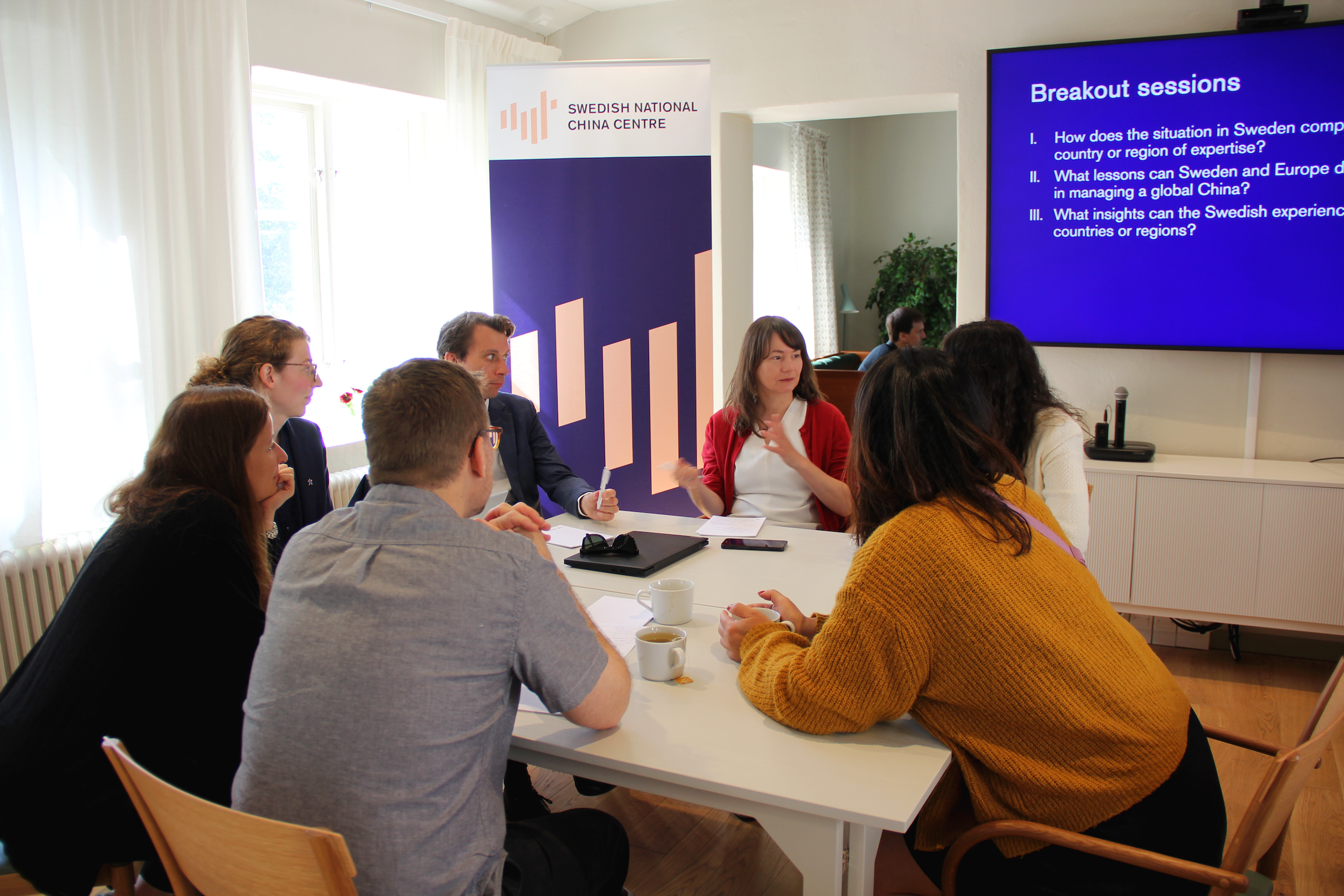
Balancing opportunities and risks has become a key factor in assessing Chinese investments, participants said. At the end of 2023, Sweden set up a new mechanism for screening foreign direct investment. As of March 2025, 1,628 investments had been submitted for review. Just one has been stopped as a result: an investment to build a major anode factory in the north of Sweden, put forward by the Chinese-owned Shanghai Putailai (PTL). Conditions imposed by the Swedish Inspectorate for Strategic Products were not accepted by PTL, and the project was scrapped.
The screening mechanism and the PTL outcome raise important questions about engaging with Chinese stakeholders in other contexts. What principles should guide the balancing of trade-offs in foreign investment decisions? What is the trade-off between security and investment? And between environmental impact and investment?
Some of these questions resonate with discussions had in Nairobi in April, where participants queried the trade-offs involved in the “pollute first and clean up later” model of development followed by both the West and China. They wondered whether Africa could find a cleaner path to industrialisation.
But security is less of a concern in Africa. As one Nairobi participant put it, the key issue for Africa is energy access – and China dominates in sectors like solar panels, wind turbines and electric vehicles. China then becomes a preferred partner, for the supply capability, the low cost and the potential for learning from Chinese technology.
Also at play, argued participants, is relations of power. Some countries, such as Myanmar, Cambodia, Laos and the Philippines, may simply not have capacity to negotiate with China effectively. Examples can, in fact, be found across all of the Global South. Instead, regional coordination may be a better approach, suggested participants.
Trade-offs in research collaboration
As China steadily advances as a major scientific power, the trade-offs shaping much of Europe’s engagement with it have become even more pronounced in research collaboration, participants explained. On the one hand, China offers significant opportunities in terms of talent, data and resources. On the other, there are concerns about weak ethical standards and infringements on academic freedom.
As government funding for universities declines in some European countries, institutions are increasingly reliant on tuition from international students, particularly from China. This creates financial vulnerabilities and raises concerns about undue influence. The issue of incoming doctoral students on Chinese government scholarships is a case in point, participants said.
At the same time, many European researchers worry about the over-securitisation of scientific collaboration. Engagement with Chinese actors is a two-way process, and dialogue with China remains essential. Rather than categorically excluding collaboration, each case should be evaluated individually based on its specific context and risks.
Jobs, jobs, jobs
Another focus area of the conversation was job creation, which is a major policy objective for governments across the world. Investment from Chinese companies in all forms of infrastructure and manufacturing holds huge potential to generate jobs. Questions were raised, however, about the quality of jobs, an issue often underappreciated by governments. Are jobs created secure and do they facilitate the transfer of skills and knowledge to workers? Or do they only create reliance and vulnerability?
Another participant noted a different side of this story. In many contexts, job creation via investments can force people out of peasant lifestyles and into the wage economy, with broad social and economic consequences – the burdens and benefits of which tend not to be shared equally. China itself has rich experience of the multiple facets of labour transformation, from the emergence of wage labour to the disruption of mass layoffs. Indeed, it is still experiencing many of these thorny policy challenges as it continues to undergo industrial transformations.

A film screening of Made in Ethiopia at the opening of the workshop underscored the human stories behind all these facets of labour. The award-winning documentary, directed by Yu Xinyan and Max Duncan, follows three women whose lives are shaped by a Chinese-developed industrial park in Ethiopia. It presents the deep complexities, challenges, opportunities and life choices each face in the shadow of the project.
Navigating competition and engagement
Many regions of the world have extensive experiences of engaging with China and Chinese stakeholders for development, green transitions and environmental management.
Southeast Asia in particular has seen deep engagement, through institutions such as the Mekong Institute, the Mekong River Commission and the Lancang Mekong Commission. However, experiences in the region also demonstrate many of the challenges in working with China, as one participant stated.
On a government level, China tends not to want to engage in huge depth and prefers to lay out its own rules and frameworks for engagement, they said. The Lancang Mekong Commission, for example, which was established in 2016 to facilitate dialogue on managing the Mekong River basin, has China in an agenda-setting position.
China’s engagement with the world is also becoming broader and more complex, encompassing not just investments and trade, but also finance, private capital and media. In Sweden, for example, Chinese firms’ involvement in the green transition involve both acquisitions and brand-new projects, both with their own dynamics. This has made engagement with China on one’s own terms ever more challenging, as one researcher noted. This is particularly apparent in the context of media influence and “discourse power”, whereby Chinese state-connected media and government officials attempt to shape media narratives about China’s global role in countries around the world.
Negative sentiments about China have also increased in some countries. Researchers at the Swedish National China Centre noted how the country’s engagement with China has shifted from a source of optimism and opportunity to a more mixed and cautious picture. Sweden faces increasingly conflicting interests and trade-offs, they stated.
When it comes to green transitions, however, not engaging with Chinese investments and equipment suppliers is simply not an option. China dominates renewable-energy equipment manufacturing and critical-minerals supply chains, particularly downstream processing. So, to achieve their own climate and development goals, Europe and other parts of the world must find ways to work with Chinese stakeholders.