The core questions raised at last month’s COP30 climate conference in Belém, Brazil, were how to raise funds to support actions that address climate change in developing nations? And, once this climate finance is raised, how to allocate it?
But the conference reached no new breakthrough agreement. Countries instead decided to establish a two-year “work programme” to discuss the climate finance issue, according to the Belém decision.
At COP29 in Azerbaijan’s capital Baku last year, countries agreed to triple financing for both mitigation and adaptation to climate change to a floor of USD 300 billion per year by 2035. It was decided that developed nations would be “taking the lead” on supplying these funds.
Countries also agreed in Baku to develop a roadmap on how to reach a more aspirational USD 1.3 trillion annually, also by 2035. The funds for this target would come from “all sources”, meaning not just developed country governments but also private sources, multilateral development banks and other avenues.
The subsequent Report on the Baku to Belém Roadmap to 1.3T was presented at COP30. It proposes that half – USD 650 billion – comes from the private sector.
At a high-level COP30 meeting on the roadmap witnessed by Dialogue Earth, Simon Stiell, executive secretary of the UN climate process, described the goal as “achievable”. He encouraged innovation in financial products, along with more involvement of private capital.
China finds itself in a complex position. Under the principle of “common but differentiated responsibilities” established for UN climate negotiations, it is not obliged to contribute to the USD 300 billion public finance pot due to its status as a developing country. But according to experts at COP30 who spoke to Dialogue Earth, overseas investments by Chinese companies are an important part of the route to the USD 1.3 trillion figure. China’s clean tech economic boom has, in other words, marked it out from other developing countries.
In its climate transparency report published last year, China complained that “developed countries emphasise global climate investment and financing, while downplaying their obligations to provide climate finance support.” This illustrates that complex position. On the one hand, China highlights the obligation for developed nations to provide climate finance in the form of grants and concessional loans. Meanwhile, it is increasingly participating in climate finance via private investment channels.
So, what is China’s role in the Roadmap to 1.3T? And given the huge shortfall recently identified in the UN Adaptation Gap Report, how does global climate funding need to change?
Dialogue Earth spoke to experts from China and elsewhere to find out.
The Roadmap to 1.3T
In November, the Independent High-Level Expert Group on Climate Finance, which has informed the Paris Agreement’s financial deliberations since COP26, issued a new report on how to provide the necessary climate finance to developing countries, excluding China.
The report says these countries will need USD 3.2 trillion annually by 2035, if they are to continue developing while simultaneously avoiding the catastrophic impacts of climate change. About 60% of that – or USD 1.9 trillion – can be provided by developing nations themselves, says the group. This leaves USD 1.3 trillion to come from elsewhere.
The Roadmap to 1.3T report, co-published in November by the COP29 and COP30 presidency teams, divides that up as follows:
● USD 300 billion in multilateral finance from development banks and climate funds
● USD 80 billion in bilateral concessional finance from developed countries
● USD 230 billion from new sources of low-cost finance, such as carbon markets, voluntary levies, debt swaps and private philanthropy
● USD 40 billion from South-South cooperation between developing nations
● USD 650 billion from cross-border private finance
Achieving this will not be easy. According to a November analysis by the World Resources Institute, the USD 300 billion in multilateral finance is achievable, but the real gap lies with the proposed USD 650 billion in private-sector money.
The Climate Policy Initiative, a think-tank headquartered in the US, has estimated that private, climate-related funding to developing nations excluding China stood at about USD 15 billion in 2022. Foreign private investments into renewable energy in the least developed countries was only USD 16 billion in that year, estimates UN Trade and Development. Raising that to USD 650 billion in the near term will clearly be challenging.
China’s contribution
This year, China has been relatively quiet about its contributions to climate funding. Wang Yi, China’s foreign minister, told the Guardian in Belém that China would provide more money to vulnerable countries. But he also said: “We don’t want to take the lead alone. We need comprehensive leadership.”
China has long aided climate mitigation and adaptation in developing nations via South-South cooperation – when developing countries work together to help one or both develop.
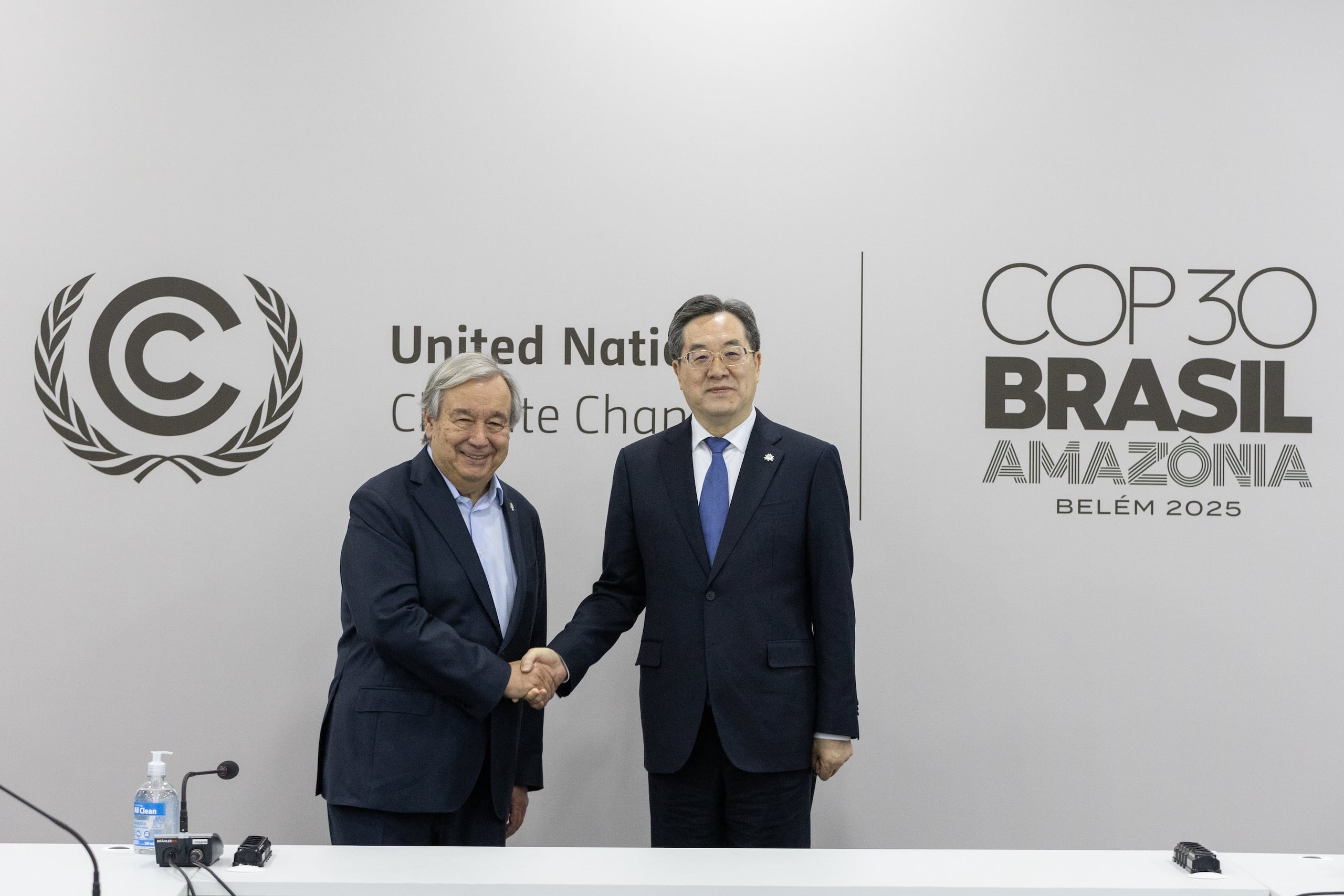
At COP29, China’s vice premier Ding Xuexiang said: “Since 2016, China has provided and mobilised more than RMB 177 billion of project funds in support of other developing countries’ climate response.” But this total, which is about USD 25 billion at today’s exchange rate, was not broken down by type of financing. The figure was given again in early November in China’s latest Paris Agreement action plan (officially known as its Nationally Determined Contribution).
“From China’s perspective, the new climate finance targets were already decided at last year’s COP in Baku,” says Kate Logan, director of the China Climate Hub and climate diplomacy for the Asia Society Policy Institute. “This year… there are no major negotiation topics that would put China’s own financial contributions in the spotlight. Instead, China has [joined] other developing countries in calling for developed countries to take greater responsibility for their climate finance commitments.”
Rebecca Nadin, director of global risks and resilience at ODI Global, a global affairs think-tank, agrees. She says China is positioning itself as a significant provider of climate finance to the developing world, partly in response to criticism from within the G77 group of developing countries. China has always stressed that its contributions are voluntary and distinct from those the developed nations have a duty to make.
“China positions itself as a climate leader within the Global South but carefully maintains boundaries against developed-country burden-sharing expectations,” she adds.
China’s contributions are not being officially tracked
Research shows China’s climate funding may go far beyond the figures detailed above, however.
The country contributed USD 3 billion a year in climate funding to developing nations between 2015 and 2021, via government bodies and policy banks, states a report published this year by the think-tank E3G. However, things then started to change. For the first time, climate-related finance from commercial banks and companies overtook the amount provided via the government.
In September this year, a report from Johns Hopkins University in the US highlighted the impressive record of China’s companies. Since 2011, they have signed up to investments of between USD 227-250 billion in overseas green-manufacturing projects. These include those that make batteries, solar and wind power components, electric vehicles and green hydrogen. The vast majority of that investment came between 2022 and 2024, with USD 210 billion committed across 54 countries. Three-quarters of it went to the Global South or emerging economies.
However, there does not seem to be any official tracking of those figures. One of the report’s co-authors is Mathias Larsen, a senior policy fellow at the London School of Economics’ Grantham Research Institute on Climate Change and the Environment. He said in September that the Chinese government itself may not know the total. Although government bodies such as the Ministry of Commerce must approve investments, that is done at the project level. The government does not seem to be tracking or coordinating these huge overseas green investments, he added.
A new corporate-led model
The other co-author of that report is Xue Xiaokang, an affiliate researcher at Johns Hopkins University’s Net-Zero Industrial Policy Lab. He tells Dialogue Earth that these private green investments are mainly motivated by profit: “We see three major motives: access to the host nation’s market, access via the host nation to another country’s market, and access to input materials.
“China’s domestic subsidies [for renewable energy] and policy support are most likely of secondary importance in driving those overseas green investments.”
The report also points out that about half of participants in the investment surge since 2022 are solar or battery makers. Xue points to two factors behind this. Solar and electric vehicle manufacturers have now matured and are operating at scale – they were ready to move overseas. Plus there is fierce competition between them domestically.
“We regard this as a new model for China’s climate governance. In the past, China’s overseas climate finance was delivered through government-led channels, such as policy banks. Now, that process is business-led,” Xue Xiaokang summarises.
Mathias Larsen describes the surge as a business-led “Belt and Road 2.0”, saying China is not simply selling affordable low-carbon products overseas. Chinese companies are, with support from their host nations, involved in green transitions, he says. “China’s total dominance of green tech… is globalising.”
Fikayo Akeredolu, who is undertaking a doctorate on Nigeria’s energy transition at Oxford University in the United Kingdom, agrees: “China’s leadership is industrial rather than ideological. It comes from scale, cost competitiveness, and long-term industrial policy rather than from setting the global rules of the transition. Other countries still influence standards, governance and finance.
“But on the technologies that matter most for rapid deployment, China is the key global player.”
Next come two questions. For how long will large investment flows be maintained? And how to assess the contribution of those investments to climate targets?
Xue Xiaokang says the flow may have slowed in 2025, and in many cases project construction has only just started, so results are not visible yet. More research will be needed in the future to calculate how they have helped the climate targets of host nations.
Debt and adaptation
If low-carbon investments from Chinese firms are driving the energy transition in developing nations, what are the limitations or challenges of this market-driven model?
“Private capital will not fund everything,” said Avinash Persaud, the special advisor on climate change to the president of the Inter-American Development Bank, during a COP30 side event. Adaptation infrastructure such as flood defences are unlikely to win private investment, for example.
Private investors prefer mitigation projects, mostly in renewable energy, as they are more likely to make a return on investment. That means less money for adaptation.
Lily Hartzell, senior policy advisor on E3G’s public banking and development team, thinks appropriate financial instruments should be used for different project types. She believes grants are still vital for adaptation activities in low-income countries.
Another core challenge is debt.
Two-thirds of low-income countries are in debt distress or at risk of it, according to a sustainability report published by the UN in June. Yet in 2023, 59 least developed countries and small island developing states spent more on servicing debt than they received in climate finance. That is according to the International Institute for Environment and Development, a think-tank headquartered in London.
“Private sector loans carry higher rates of interest, are shorter term, and cannot be compared with concessional loans. If low-income nations rely on commercial loans for public investment, they are under more pressure to make repayments and more likely to fall into a debt crisis,” says Fikayo Akeredolu.
“Loans themselves are not bad. They just need to be used very carefully,” says Hartzell. “Currently, the most important thing is still to scale up available climate finance, since the funds flowing to developing countries are insufficient to meet their mitigation and adaptation needs.”
Mathias Larsen, though, remains optimistic about the surge in Chinese overseas investment seen in 2022-2024.
“The crucial question is if and how the host country is able to make use of that opportunity.” Some countries, Larsen says, have realised that importing cheaper products from China does not benefit local development or employment. “Therefore, they put in tariffs and local content requirements to ensure that some parts of the value chains are inside the countries.” Direct investment by Chinese firms, though, may help achieve industrialisation, employment and development targets, he adds.
As Avinash Persaud told Dialogue Earth at COP30: “China has the capacity to sell the developing world all the solar and wind. Today, politics gets in the way of something that would perhaps be one of the most powerful economic development strategies for both countries.”