Climate

Financial pledges brighten chances of weak Doha deal

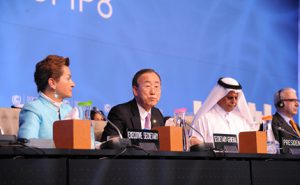
With some European countries pledging money and all countries agreeing to a second commitment period under the Kyoto Protocol, chances of a deal brightened on the penultimate evening of the UN climate summit in Doha.

With some European countries pledging money and all countries agreeing to a second commitment period under the Kyoto Protocol, chances of a deal brightened on the penultimate evening of the UN climate summit in Doha.

The deal, however, will be too weak to have any discernible impact on global warming. The World Meteorological Organization has just warned that concentration of carbon dioxide – the main greenhouse gas (GHG) that is warming the earth – is at a never-before level. The United Nations Environment Programme has warned that current commitments to arrest GHG emissions fall around 40% short of what is needed to keep temperature rise within two degrees Celsius. A recent World Bank study paints a frightful picture of a world that may be four degrees warmer than pre-industrial levels.

But representatives of 194 governments gathered in Doha for the annual summit of the UN Framework Convention on Climate Change (UNFCCC) continued their game of doing as little as possible to combat climate change. “We can only do what is politically acceptable back home,” said a member of the US delegation. Xie Zhenhua, Vice Chairman of China’s National Development and Reform Commission, was confident that there would be “an outcome that may not be to the liking of all, but can be accepted by all” governments.

That “balanced outcome”, as Xie put it, came after Britain, Germany, France, Sweden and Denmark announced that they would be paying poor nations to help combat climate change and move to a greener development path. Negotiators from developing countries were still struggling to put these pledges into the final agreement text. With the US, Canada, Japan, Russia and New Zealand firmly opposed to any such move, the outcome was uncertain.

But with a large part of negotiations completed for the second commitment period of the Kyoto Protocol – though crucial issues remained outstanding – Christiana Figueres, UNFCCC Executive Secretary, was confident that negotiations would not collapse, and the world could move towards an agreement under which all countries would make stronger commitments to fight climate change after 2020.

The current commitments under the protocol are very weak indeed, and many developed countries have not even made any pledge about the extent to which they will reduce their GHG emissions. Xie pointed out that the “question is ambition of emission reduction – it is now insufficient to keep warming under two degrees, as science says we need.” But BASIC countries – Brazil, South Africa, India and China – indicated that they were willing to move forward rather than derail negotiations.

In a post-2020 regime where all countries may have obligations to arrest GHG emissions, the question of equity will be paramount, said Mira Mehrishi, head of the Indian delegation. The US delegation has a very different notion of equity than that of developing countries – mainly India – and this is a likely sticking point in future negotiations.

Cookies Settings

Dialogue Earth uses cookies to provide you with the best user experience possible. Cookie information is stored in your browser. It allows us to recognise you when you return to Dialogue Earth and helps us to understand which sections of the website you find useful.

Required Cookies

Required Cookies should be enabled at all times so that we can save your preferences for cookie settings.

Dialogue Earth - Dialogue Earth is an independent organisation dedicated to promoting a common understanding of the world's urgent environmental challenges. Read our privacy policy.

Cloudflare - Cloudflare is a service used for the purposes of increasing the security and performance of web sites and services. Read Cloudflare's privacy policy and terms of service.

Functional Cookies

Dialogue Earth uses several functional cookies to collect anonymous information such as the number of site visitors and the most popular pages. Keeping these cookies enabled helps us to improve our website.

Google Analytics - The Google Analytics cookies are used to gather anonymous information about how you use our websites. We use this information to improve our sites and report on the reach of our content. Read Google's privacy policy and terms of service.

Advertising Cookies

This website uses the following additional cookies:

Google Inc. - Google operates Google Ads, Display & Video 360, and Google Ad Manager. These services allow advertisers to plan, execute and analyze marketing programs with greater ease and efficiency, while enabling publishers to maximize their returns from online advertising. Note that you may see cookies placed by Google for advertising, including the opt out cookie, under the Google.com or DoubleClick.net domains.

Twitter - Twitter is a real-time information network that connects you to the latest stories, ideas, opinions and news about what you find interesting. Simply find the accounts you find compelling and follow the conversations.

Facebook Inc. - Facebook is an online social networking service. China Dialogue aims to help guide our readers to content that they are interested in, so they can continue to read more of what they enjoy. If you are a social media user, then we are able to do this through a pixel provided by Facebook, which allows Facebook to place cookies on your web browser. For example, when a Facebook user returns to Facebook from our site, Facebook can identify them as part of a group of China Dialogue readers, and deliver them marketing messages from us, i.e. more of our content on biodiversity. Data that can be obtained through this is limited to the URL of the pages that have been visited and the limited information a browser might pass on, such as its IP address. In addition to the cookie controls that we mentioned above, if you are a Facebook user you can opt out by following this link.

Linkedin - LinkedIn is a business- and employment-oriented social networking service that operates via websites and mobile apps.