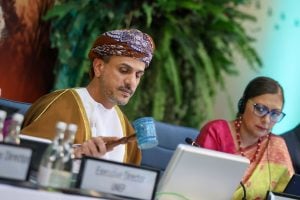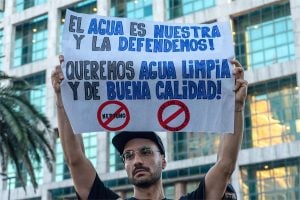
The withdrawal of the US from international bodies working on climate change, biodiversity and energy has prompted condemnation, if little surprise.
On 7 January the country’s president Donald Trump cut ties with 66 international bodies as he continued a push to dismantle US involvement in global efforts to fight climate change and safeguard biodiversity, as well as wider multilateralism.
“Many of these bodies promote radical climate policies, global governance, and ideological programs that conflict with US sovereignty and economic strength,” said the White House.
What this will mean in practice is not yet clear, but the official order says all US departments and agencies should take “immediate steps” to withdraw involvement and funding as soon as possible from 31 UN and 35 non-UN entities.
They include the UN Framework Convention on Climate Change and the Intergovernmental Panel on Climate Change. Others on the list range from major global environmental bodies that work on biodiversity, to specialised parts of the UN that coordinate work on oceans, water and energy.
Those working on these issues in the Global South are still reeling from last year’s severe cuts to US overseas spending, including the shutdown of the US Agency for International Development (USAID) and withdrawal from the World Health Organization. As well as shuttering projects working on health, poverty reduction, clean energy and conservation, the closure of USAID could result in hundreds of thousands of deaths per year according to some estimates.
Marco Rubio, US secretary of state, linked the latest cuts to Trump administration fights against not just the previous consensus on climate change but wider cultural battles.
In a press statement, he said: “From DEI [diversity, equity and inclusion] mandates to ‘gender equity’ campaigns to climate orthodoxy, many international organizations now serve a globalist project rooted in the discredited fantasy of the ‘End of History’”
“Their work is advanced by the same elite networks – the multilateral ‘NGO-plex’ – that we have begun dismantling through the closure of USAID,” he added.
Walking (further) away from multilateralism
The US had already slashed much of its involvement in multilateral efforts on climate, notably by withdrawing from the Paris Agreement on day one of Trump’s second stint as US president last January.
Departing from the IPCC and UNFCCC will pile further pressure on global efforts to tackle climate change, which notably failed to make significant progress at the recent UN climate meeting in Brazil.
“The United States would be the first country to walk away from the UNFCCC … having a seat at the table in those negotiations represents an ability to shape massive economic policy and opportunity,” said Manish Bapna, president of the Natural Resources Defense Council NGO.
This latest example of the US abandonment of multilateralism is also likely to accelerate ongoing rearrangements in relationships around climate, energy and multilateralism.
John Kerry, a former US secretary of state and former special presidential envoy for climate, told Business Green: “This is par for the course. But it doesn’t change the fact that it’s a gift to China and a get-out-of-jail-free card to countries and polluters who want to avoid responsibility.”
Some of the bodies being abandoned do not receive US funding, such as the Economic Commission for Latin America and the Caribbean, which has historically shaped debates on inequality, industrial policy, commodities and more recently climate-development links. But the withdrawal is likely to leave space in the development of global and regional policy that will be filled by Latin American states, Europe and increasingly China.
The Chinese government response has so far been muted, with a spokesperson saying the US withdrawals were “nothing new” and reiterating a commitment to multilateralism and the UN.
Science likely to suffer
Science and on-the-ground work to protect the environment could also suffer from Trump’s latest decree, especially if the IPCC’s ability to work on climate science is disrupted. It comes against a background of cuts to and attacks on climate science from his government, both domestically and internationally.
“The IPCC is where the global scientific community rigorously assesses what we know about climate risks, impacts and solutions. Individual US scientists may still contribute, but our country will no longer be able to help guide the scientific assessments that governments around the world rely on,” said Delta Merner from the Union of Concerned Scientists NGO.
IPCC chair Jim Skea said the panel would continue to work on the scientific reports already agreed by its member governments and to make decisions by consensus among these members. “Our attention remains firmly on the delivery of these reports,” he said.
Trump also ordered the US withdrawal from major biodiversity-focused organisations, the International Union for Conservation of Nature (IUCN), and Intergovernmental Science-Policy Platform on Biodiversity and Ecosystem Services (IPBES), as well as the regionally important Inter-American Institute for Global Change Research (IAI).
This could cause major damage to efforts to monitor and conserve species, especially in the Global South where data and resources are already limited and much work relies on international support.
The US is the fifth largest contributor to the IUCN budget, which supports species monitoring and the widely cited ‘red list’ of endangered species, as well as work on solutions to climate change and biodiversity loss. IPBES tries to bridge biodiversity science and policy, producing influential reports and building capacity in the Global South to tackle biodiversity problems.
David Obura, the chair of IPBES, said the group had not received any formal notification from the US but that it “regrets the deeply disappointing news”.
“While it is clearly the prerogative of Governments to withdraw from global processes, like those of IPBES, it is important to remember that this does not change the science or the relevance of that science to the lives and livelihoods of people in every community, in every part of the world,” he added.
“Unfortunately, we cannot withdraw from the fact that more than 1 million species of plants and animals face extinction.”
An IUCN spokesperson also expressed regret and said: “We deeply value the United States’ contributions over many decades of fruitful collaboration within our union, and we hope that this decision can be reconsidered in the near future. IUCN’s doors remain open for collaboration and partnership.”
Also on the chopping block is US participation in the UN Collaborative Programme on Reducing Emissions from Deforestation and Forest Degradation in Developing Countries, better known as UN-REDD. This works to combat deforestation, with projects in Latin America, Africa and Southeast Asia. The US was not a contributor to the Redd budget.
A number of bodies working on energy will have to continue without Trump’s support, as the president maintains his emphasis on fossil fuels over renewables. These include the International Renewable Energy Agency, the International Energy Forum and the Renewable Energy Policy Network for the 21st Century.
This story was updated after publication with comment from IPBES, IPCC and IUCN.