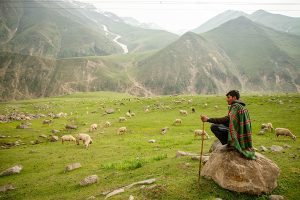
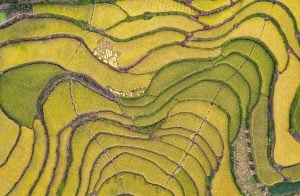
The Agaw people in the Western Highlands of Ethiopia have long practised sustainable land management. Their Indigenous techniques include terracing agricultural land to conserve water, rotational grazing of animals, and soil restoration using native species.
The techniques, which would today be labelled “traditional ecological knowledge” (TEK), have fostered ecological stability across generations. But the Agaw now face increasing pressure due to drought and soil erosion, both of which are worsening in the face of climate change.
Editor’s note:
This article is part of Dialogue Earth’s Indigenous Voices fellowship. The eight fellows are Indigenous journalists and storytellers from across the Global South. The fellowship aims to foreground not just Indigenous issues, but also the storytelling, reporting and insights of Indigenous journalists themselves.
“We learned from our parents and grandparents how to care for this land. The soil gives to us only if we also give back to it,” one Agaw community member told me, highlighting the intergenerational values guiding local management.
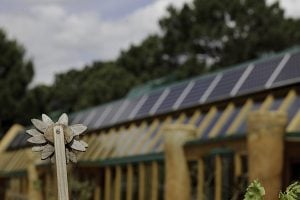
In response, the Agaw community – my community – has begun integrating TEK with renewable-energy technologies to create adaptive, culturally grounded responses to environmental change. A particularly successful example is the use of solar-powered pumps to bring additional water to traditional terraces.
This fusion of the traditional and the modern has enhanced agricultural resilience and expanded energy access, while maintaining the community’s spiritual and ecological values.
Bayeh Tiruneh, an expert with the Nature and Biodiversity Conservation Union (NABU) in Ethiopia, said: “The Agaw experience offers a compelling model for how Indigenous wisdom can work synergistically with modern energy solutions to foster climate resilience and equitable development.”
Solar irrigation
Solar-powered water pumps now support year-round cultivation in Ankesha Guagusa, the district where the Agaw community resides, and where inconsistent rainfall and soil erosion have long impeded agriculture, explains Zemen Yirdaw, head of the district’s irrigation and lowland areas office. These pumps draw groundwater or river water for irrigation, enabling farmers to mitigate drought and produce food more consistently.
Agaw farmers in Ankesha Guagusa are integrating this technology with traditional terracing methods and water-sharing customs, establishing a system that conserves soil and water while enhancing crop productivity.
“With solar pumps, I can water my crops when there is no rain. We still use the terracing our ancestors taught us – it works even better now,” Guday Tessema, an elder farmer, told me.
The carved steps of Indigenous terracing slow water flow, preventing erosion while enhancing absorption. Meanwhile, solar irrigation systems channel water across the terraced slopes, reducing run-off and directing moisture deep into the soil. “Together, they form a living infrastructure that conserves water, protects soil … and supports long-term, sustainable agricultural productivity,” said Molla Asmare, a researcher at Bahir Dar University.
The systems are typically installed and maintained through small cooperatives, with technical support from NGOs such as NABU and from local government initiatives under the Agaw Awi Administrative Zone. Water use remains governed by community norms, reinforcing traditional rules of equity and conservation.
Technology alone cannot guarantee progressMeseret Kassahun, GJLEO
“We are witnessing higher yields and healthier soils. It is a strong example of modern tools reinforcing Indigenous systems,” noted Muluken Getachew, an agricultural extension officer based in Ankesha Guagusa district.
Atirsaw Jajew, another researcher at Bahir Dar University, said the success of these systems is down to the community-led design. “Farmers participate in planning and placement, often adjusting usage based on traditional seasonal knowledge,” he said. “In this way, solar irrigation becomes a technical enhancement to, rather than a replacement of, existing environmental knowledge.”
Community perspectives
While solar irrigation is widely appreciated in Ankesha Guagusa for its practical benefits, perceptions of the technology vary significantly.
“Now we grow food even during dry months. However, without support, we cannot afford repairs or new panels. It is too costly for families like mine,” Zegeye Alemu, an elder community member told me.
Another elder, Bogale Agajie voiced concern that newer technologies could gradually replace traditional practices or reduce the cultural authority of elders in agricultural matters.
A 26 year-old farmer, Hymanot Tamir, was less worried. “This technology helps us make money and feed our families,” he told me. “We still honour the old ways, but we need to move forward.”
Other young farmers I spoke to expressed similar sentiments. For them, solar irrigation represents both a tool for economic empowerment and a means of remaining on ancestral land rather than migrating to urban areas for work.
“Before, we walked hours to fetch water. Now, the pump gives us water near the home. I have more time for the children and our small crops,” said Alefech Tarekegn, who like many women in Agaw society manages subsistence farming and household water needs.
Who makes the decisions about solar irrigation is an issue, however.
“We benefit, but we are not making decisions,” another community member named Ergibie Ayele told me. “Men decide where the pumps go and how they are used,” she added.
This gender imbalance in decision-making remains a key challenge. Although women are among the primary users and beneficiaries of irrigation, their voices are often excluded from infrastructure planning. In response, local NGOs such as Green Justice and Local Empowerment Organization (GJLEO) have begun training women in technical maintenance and leadership roles to enhance gender equity in solar-energy adoption.
Without support, we cannot afford repairs or new solar panelsZegeye Alemu, Agaw elder
“When women gain skills in solar technology, they not only maintain the systems but also lead community decisions,” noted Beza Misganaw, a program coordinator at the GJLEO. “This shift ensures sustainability while empowering women as equal actors in the energy transition.”
Meseret Kassahun, of GJLEO, emphasised the importance of equity in solar adoption: “Technology alone cannot guarantee progress. Without financial support, inclusive planning, and sensitivity to local culture, even the best interventions risk deepening existing disparities. True sustainability means addressing both technical and social dimensions together.”
Tesera Melese, who works at NGO the Organization for Rehabilitation and Development in Amhara (ORDA), said: “When women are excluded from energy planning, we miss out on their insights – and the systems are less effective.”
Churches as cultural anchors for solar power
Another important innovation is the installation of solar panels in local religious institutions. In Ankesha Guagusa district, solar systems now provide consistent, clean electricity to the churches of St George, St Michael, and Abune Gebre Menfes Kidus. These are all part of the Orthodox Tewahedo tradition and sites that once relied entirely on natural light and firewood. They are central to community life and thus serve as influential examples of sustainable energy use.
Abba Haymanot, a senior priest of St George Church, said: “Our church is now ignited without smoke or kerosene. Solar energy is a gift that helps us protect God’s creation.”
Solar installations support environmental health and spiritual principles by reducing deforestation and air pollution, reinforcing a holistic view of stewardship.
Women, previously responsible for collecting firewood for religious gatherings, have noted the relief solar power brings. “We do not need to gather wood every week for lighting. It saves our time and the forests,” said Kebebush Zelalem.
The symbolic role of these institutions in normalising solar technology cannot be overstated. When community leaders endorse and model clean energy use, it legitimises the transition for households and farms.
Barriers to scaling
Despite these successes, significant challenges remain in scaling and sustaining the integration of TEK and solar energy across Agaw communities.
The financial burden is one of the most pressing issues. Asmare, a researcher and an entrepreneur in solar panel technologies, said: “A solar irrigation system costs about 360,000 ETB [USD 2,600). For most Agaw families, this is very expensive compared to their household income.”
Ongoing maintenance also requires specialist knowledge and access to spare parts. The emergence of training programmes has helped, but this knowledge, and the parts, both remain limited in remote areas. Muluken Zegeye, a renewable energy specialist at Bahir Dar University, said: “Without targeted subsidies or financing options, adoption among poorer households will stall, limiting further expansion.”
Getahun Eshetu from Bahir Dar University also pointed out that TEK remains undervalued in national energy planning frameworks. Few mechanisms exist for formally incorporating TEK into climate or energy strategies, hindering the institutionalisation of community-led approaches.
“TEK holds deep sustainability wisdom, and while some policies have begun to acknowledge it, much more can be done. What we need is a framework that meaningfully values Indigenous solutions alongside technical ones,” he said.
Toward culturally responsive renewable-energy transitions
The Agaw people’s integration of TEK with solar energy demonstrates that modern technology can complement, rather than displace, Indigenous knowledge systems. However, for this synergy to thrive, they say it must be supported by equitable financing, inclusive governance, and policy frameworks that respect TEK.
As Ethiopia transitions toward renewable energy, the Agaw experience offers valuable lessons. It shows that resilience is not just technical but cultural, relational and rooted in community agency. By honouring the past while innovating for the future, the Agaw community charts a path that could inform sustainable transitions across the Global South.