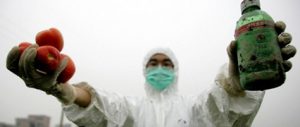
The Chinese people have had their imaginations challenged by a series of food and drug safety scares. In a little over a decade, we have seen alcohol which is actually methanol; seafood soaked in formalin; the Fuyang milk-formula scandal, the Sudan Red scare, the melamine scandal, “gutter oil”, and gelatine rendered out of used shoe leather. Now even the capsules used to deliver drugs have been found to contain toxins.
None of us can be certain that any foodstuff or drug is safe, from baby milk powder through to cooking oil. Nor can we be sure that any company – be it a backstreet workshop or a big state-owned firm – is producing safe food and drugs. Consumers were originally shocked. Now, they are simply numb. It seems the Chinese have got used to poisoning each other.
It is the nature of the problem itself that has allowed it to become so widespread. China’s food and drug safety problems are structural, caused by a number of different factors and actually exacerbated by the system. No single response to any one incident will provide a solution.
First, let’s take the economics of food safety. We must ask the most basic of questions: why do companies manufacture and use toxic foods and drugs? Why do even officially registered companies, even those of considerable size, do so? The answer lies with our overall economic structure.
In China, sectors such as energy, heavy industry, chemicals and communications, often very profitable, have high barriers to entry in order to protect the interests of state monopolies. There is little space left for private firms and small and medium enterprises (SMEs) – and when too many companies chase the limited opportunities remaining, excessive competition results.
Cheap goods and fake food
In the food and drug sectors, the financial and technical barriers to entry are low. This creates a structural problem: companies tend to be small, scattered, of low quality and unable to innovate. And so they compete dishonestly. Excessive competition leads to a race to the bottom, with costs being cut through fakery and inferior products. Any firms that actually care about safety become less competitive and eventually go under.
Not only does the bad money drive out the good, food and drug manufacturers are under a massive tax burden. From ordinary taxation (higher than in other nations), to more China-specific costs including road and bridge tolls, business registration and inspection fees – profits are wrung out at every stage of the food industry. Before a food or drug reaches the consumer, huge additional costs are incurred for raw materials, transportation, production, distribution and retailing, preventing both manufacturers and retailers from growing. With food and drug supply chains becoming more complex and the market more open, those burdens are passed onto the consumer by fair means (increased prices) or foul (cheap but toxic products). Most countries monitor food safety at the farm and the factory. But in China food safety issues can arise anywhere.
Second, there’s government regulation: a developing market economy and continued government involvement in that market mean greater government ability to obtain income. But ability to manage has decreased. There have been obvious legislative successes: the Food Safety Law, the Drug Control Law and the Regulations on Supervision and Management of Medical Equipment have all been promulgated, and a number of national standards are now in line with international practice.
But these ever more detailed laws have failed to improve food and drug safety. The problem is implementation. Several government departments are responsible for food safety, and powers and responsibilities are fragmented. The Ministry of Health is in charge of overall coordination and risk evaluation; the Ministry of Agriculture covers agricultural products; the General Administration of Quality Supervision, Inspection and Quarantine monitors imports, manufacturing and processing; the Drug Supervision Administration is in charge of medicines; while food products on the market are mostly the responsibility of the industrial and commercial authorities.
This leads to two problems. One, overlapping supervision increases costs for the companies. And two, when problems arise, the authorities pass the buck. Fees are taken – but not responsibility. Both of these problems make it harder to guarantee food safety. On a trip to America, former premier Zhu Rongji paid a visit to the US Food and Drug Administration, a powerful government agency that has been in existence for a century. On his return to China, Zhu set up a similar body in China, but for various reasons it failed to play its hoped-for role and was broken up.
Major design flaws at the top worsen problems with implementation at the grassroots. Laws and national standards are not, generally, strictly enforced. Local officials lack motivation to enforce these rules and often act on behalf of dishonest companies as much as on behalf of the state. National law becomes the basis on which those officials draw benefit from business – in exchange, laws are laxly enforced, or simply ignored. This extra cost for the companies may then be passed on to the consumer in the form of lower-quality products.
Better food regulation needed
Local officials become part of the low-quality food chain and share in the profits. Naturally, they have no interest in eliminating the problem. This is not just apparent in the food and drug sectors. The recent cases of pyramid scheme fraud in Beihai and Nanning, the sex industry in the Pearl River Delta – these sorts of problems are also tied up with the interests of local officials. Government aims and objectives are not implemented and so governance fails. Worse, with this culture already entrenched, strengthening enforcement in any one area actually gives officials more power to extract benefit – creating the opposite effect to that intended. The more invested in enforcement, the more power the officials have, and the less effective governance becomes.
Finally, there’s consumer and public oversight. China’s particular policy and legal environment cannot meet the political needs of a modern society and citizenry. Media supervision and public participation are limited, non-governmental supervisory groups cannot act, self-regulation by industry groups is underdeveloped and public law suits against food and drug firms fail to get through the courts. The food and drug industries lack the pressure of social oversight, and so the final and most direct line of defence is lost – and safety problems just get worse.
Our lives are determined by the systems we live in. In China food and drug safety isn’t just a question of economics. It is also a matter of regulation, and more, a matter of our political and legal system. Management of these structural issues without overall reform, with just the blind expansion of enforcement powers, will be useless.
Changing this system through economic, administrative, social and legal channels needs the continued participation of the victims – the citizen as consumer. And this participation must extend beyond supervision and enforcement in the food and drug sectors into all other areas: demanding economic justice, breaking up monopolies and widening market access; shutting down production, pursuing criminal liability, and demanding huge punitive damages; seeking judicial independence, improving law and regulations, expanding legislation, and promoting the rule of law; launching citizen movements, establishing NGOs, and promoting political reform.
Only widespread participation and overall reform can provide hope for a complete resolution. This will be no easy path to take, but when it comes to structural problems there are no short cuts.
Tang Hao is deputy professor at South China Normal University, a Fulbright scholar and a columnist.