Declining crop diversity in China is threatening its ‘food sovereignty’, the right for those who produce, allocate and consume food to define their own food systems, a Chinese agriculture expert has warned. Pressure from modern breeding techniques, GM crop imports and commercial seeds mean that many of China’s local varieties have no market and may even disappear.
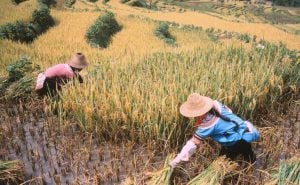
Song Yiching, an agricultural researcher at the Chinese Academy of Sciences, has been studying crop biodiversity in the south-west provinces of Guangxi, Yunnan and Guizhou since 2003. She told chinadialogue that local varieties have disappeared, pushed out by commercial seeds. In Shitoucheng in Yunnan only a few farmers are still planting highland barley, which they use to brew a local drink.
Climate change is compounding the problem for many farmers. The locals in Shitoucheng used to make a lot of rapeseed oil, but climate change has brought more pests and upped spending on pesticides, making rapeseed uneconomic to grow. Farmers have now switched to wheat, hybrid corn and rice.
Song describes seeds as living and constantly changing – they are able to acquire new genes to cope with environmental changes. Local varieties are suited to local climates – but commercial seeds may not be able to adapt.
She says that many commercial seeds are hybrids of identical or similar parents. This gives many hybrid varieties a narrow genetic base and greatly reduces diversity.
Song would like to see more local agricultural brands, such as the Yidunqing potatoes of Hebei.
Yidunqing potatoes have been planted in Huai’an county for more than 40 years. Recent improvements to the crops and determination to stick to organic techniques has earned the variety praise at agricultural exhibitions. And the farmers’ ability to retain seed potatoes and control the entire process has given them more power.
A sustainable demonstration farm was set up to grow the potatoes and other organic products. The villagers have registered an NGO – the Yidunqing Development Association – to promote and sustain traditional crop varieties and increase their bargaining power on the potato market.
Seed sovereignty
Seeds sold on the market, known as commercial seeds, are generally high-yielding or have advantages such as resistance to stem breakage or pests. This makes them popular with farmers and they quickly dominate the market. But Wang Dianchun of the Qingdao Agricultural Sciences Institute explained that seed companies sell hybrid seeds, which produce a crop but no viable offspring seeds. This means the farmers need to buy seeds every year, limiting their control and profits.
Ownership of the seeds and being able to improve and exchange seeds, is known as seed sovereignty. Like the right to set prices, it is fundamental for farmers. But Song Yiching told chinadialogue that in China today such rights are being lost.
Seeds also play cultural, as well as ecological, roles. The retention and breeding of different varieties is a part of rural culture. As Song says, “biological diversity, cultural diversity and diversity of farming incomes are all closely related.” Protection of biodiversity and farmers’ rights needs to consider the role of farmers as both continuers of tradition and innovators.
Seed sovereignty is not just an issue for China. In 2011, thousands of Indians campaigned against Monsanto, marching to protect seed and food sovereignty and protest against the company’s take-over of agriculture. Monsanto is a multinational agricultural biotech firm and a leading producer of GE seeds, with 70% to 100% of the market for many crop seeds.
Vandana Shiva, an Indian environmentalist and physicist, organised that campaign. She has argued that expansion of the big seed companies is making commercial seeds more common, while intellectual property laws are protecting the companies’ patents. That meant farmers were losing the right to breed new varieties or even retain their seeds. And the need to buy seeds and pesticides every year was reducing profits, making farmers’ lives harder.
Professor Zhou Li of Renmin University’s School of Agricultural Economics and Rural Development, told chinadialogue that there are three levels to food sovereignty: farmers have the materials needed for production and the right to decide how to grow crops; consumers have the right to decide what to buy; and the state has the right to ensure food security.
These rights have long been hidden, and are ignored by many. In China all three of these aspects are under threat, but most of all the farmers’ sovereignty, including seed sovereignty.
Many farmers have lost their land during the rural reform process. The transfer and requisition of village land was a major issue at the Third Plenum of the 18th CPC Central Committee. Rural reforms are encouraging large scale agricultural operations and small scale farmers may see their interests squeezed further.
Li Changping, head of Hebei University’s Rural Construction Institute, told chinadialogue that “for farmers to protect their rights, the priority is to maintain the existing rural land system of communal ownership and the household responsibility system (and prevent land being owned by capital), then to retain certain seeds.”
But China is only just begining to tackle the issue of food sovereignty. Professor Yan Hairong of Hong Kong Polytechnic University raised the question of food sovereignty over the import of GM soya beans.
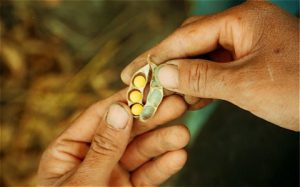
She said in an interview that high amounts of soya bean imports are a crisis of national food sovereignty. In 2012, 80% of China’s soya consumption was of imported GM beans, which are squeezing domestic soya crops out of the market. In the soya-growing province of Heilongjiang 64.7 million mu (5 million hectares) of land were planted with the crop in 2010, but by 2012 this had fallen to less than 40 million mu (3 million hectares). Domestic non-GM soya is being squeezed out of the market. Meanwhile the cost of imported soya has rocketed from US$265 a tonne in 2006 to more than US$599. The knock-on effect of more expensive soya products will be borne by consumers.
The effects of imported GM soya are affecting the sovereignty of farmers, consumers and the state. Liu Denggao, head of the China Soya Association, told chinadialogue that the soya industry has been taken hostage, but that in terms of sovereignty “we should decide ourselves what to grow, what to import, and how much of it to import.”
The International Institute for Environment and Development has provided a short film on the issue, available below or online if you are not able to view it: