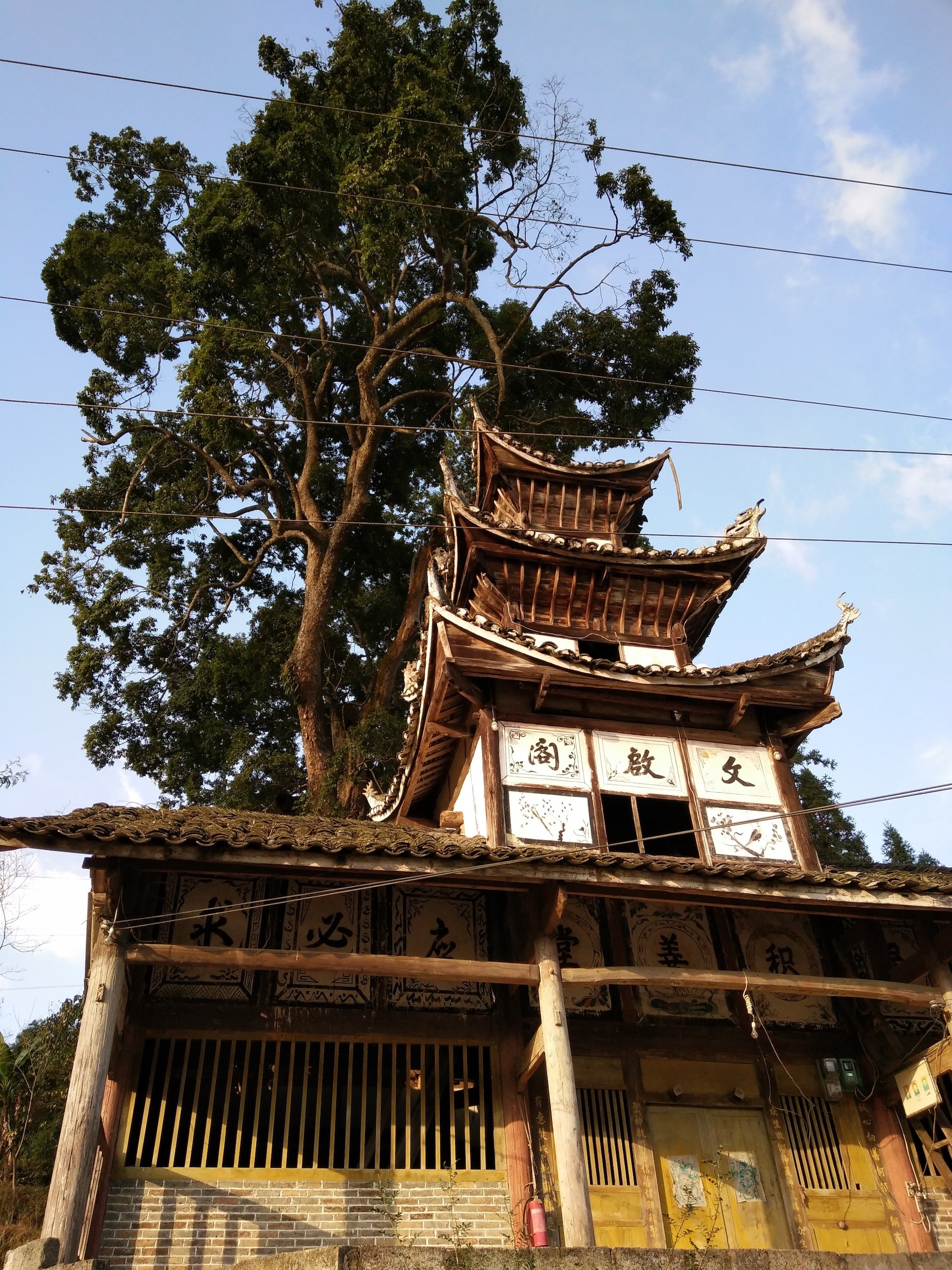
A flourishing nanmu tree towers over a four-storey Taoist temple, perhaps standing guard over it, perhaps taking refuge behind it.
The tree, in Guizhou province’s Wuchuan county, is about 400 years old. Timber from the species, Phoebe zhennan, is extremely valuable and was once used in the construction of imperial temples. Nanmu trees were harvested for their timber for centuries and Phoebe zhennan is now listed as Vulnerable on the International Union for Conservation of Nature’s Red List. Yet here, in the Wenqige temple grounds, an individual survives.
Nor is it a rarity. Our survey found many ancient trees surviving behind the walls of China’s temples. This made us wonder if the temples are really helping protect China’s ancient trees? If so, how? And can this inform our own efforts to protect biodiversity?
Trees and temples
We came across that particular nanmu tree during a 2017 survey of ancient trees in settlements in the ethnic minority areas of the south-west. In the years since, we have carried out multiple surveys in 1,324 of China’s 2,846 county-level regions. From these we have built a database of ancient trees surviving on temple grounds. We now have complete data for 5,125 Buddhist temples (about 15% of the total) and 1,420 Taoist temples (about 17%).
Our data shows that it is extremely common for temples to retain ancient trees, particularly in the east of China. We recorded 46,966 trees of over a century old across 6,545 temples – or 7.2 trees per temple. The density of ancient trees inside those sites is 7,000 times higher than outside.
Some well-known sites are home to many individual trees. In Beijing, Tanzhe Temple, a Buddhist place of worship built in around 307 AD, contains 178 ancient trees; nearby Jietai Temple (first built during in the 7th century) has 88. But smaller and lesser-known sites can have more than their share. Tieding Temple, on the outskirts of Chongqing, is tiny (about 0.03 hectares) yet home to four ancient white fig trees (Ficus virens). These are planted as an alternative to the bodhi tree (Ficus religiosa) which is sacred in Buddhism but hard to grow in China.
Often, the ancient trees growing within temple walls are older than those surviving outside, with the oldest being over two millennia old. That’s about as old as White Horse Temple in Luoyang, regarded as China’s first official Buddhist temple and built in 68 AD. This indicates that some of the ancient trees were growing when the temples were built, or were planted at the same time.
The temples we surveyed preserve 5,989 ancient trees from 61 of the 130 tree species on the China Biodiversity Red List that survive in areas inhabited by humans. Eight of those species, such as Carpinus putoensis and Firmiana major, are found nowhere else but in temple grounds. Carpinus putoensis, or Putuo hornbeam, has only one surviving example in the wild, a 200-year-old at Huiji Temple on Zhejiang’s Mount Putuo. Firmiana major was for a time thought to be extinct in the wild, but 200-year-old trees were later found in two temples in Yunnan.
Trees and religion
How do these temples become refuges for ancient trees? It’s to do with the importance of trees in Buddhist and Taoist culture, and Chinese tradition.
In Buddhism, certain plants are special. Scripture lists “five trees and six flowers” which should be planted in temple grounds. These are the bodhi tree, the lofty fig, the talipot palm, the betel palm and the palmyra palm. The flowers are the sacred lotus, the giant crinum lily, the yellow ginger lily, the great white frangipani, the white champaca and the golden lotus banana. These, or close relatives and similar-looking alternatives, are therefore common in Buddhist temples.
In Chinese traditional culture, trees in the cypress family, such as Oriental arborvitae and Chinese juniper, are believed to ward off evil and symbolise longevity. They also represent immortality in Taoism and purity and serenity in Buddhism. Such trees are often present in temple grounds.
Temples are often built in wooded areas, with naturally growing trees included within their walls. Those trees make up an important subset of the ancient trees we studied. Millennia of logging have meant many natural forests and ancient trees have disappeared, but those protected by temples survive through the centuries.
Protecting and propagating
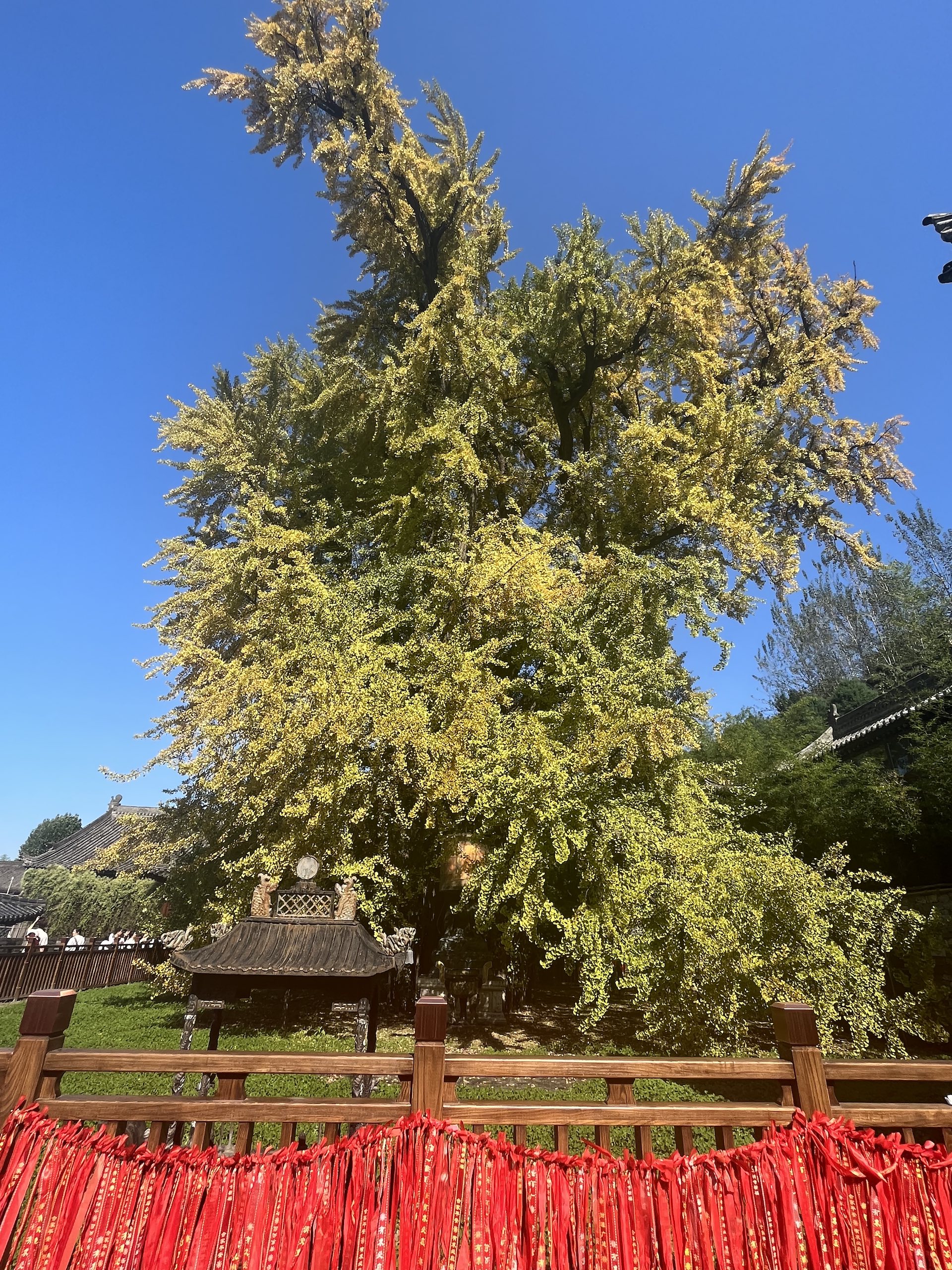
Interestingly, some trees valued in Buddhist culture grow in temples far beyond their natural range. The gingko, for example, grows more easily in China’s climate than the sacred bodhi tree, so is sometimes chosen as an alternative. At the end of the last ice age, about 11,700 years ago, the gingko was found only in a few refuges, including around Mount Tianmu in eastern China and the Dalou Mountains of the south-west. Today, it is found in Buddhist temples throughout China, with many examples over a thousand years old. We think the arrival of Buddhism in China, about two millennia ago, led to the tree being spread from its few natural homes.
It’s often thought that transportation difficulties in those times meant plants could not easily be propagated beyond their natural habitats, particularly in the south-west, with its difficult terrain. But trees sacred to Buddhist culture spread across ancient China. We found over 20 other species growing outside their natural habitats, including the Buddhist pine and Chinese yew.
The ecological value of culture
We found huge diversity in the ancient trees growing in temple grounds – 534 species in all. Most of those also thrive in natural forests and are commonly seen. But in areas long subject to human activity, those ancient trees could be the last surviving examples. Temples provide a last refuge for those endangered tree species, demonstrating the particular value of those sites to biodiversity protection.
Cases of cultural practices aiding biodiversity conservation are extremely common, both in China and worldwide. Two further examples are the fengshui forests of southern China and the church forests of Ethiopia. Culturally protected biodiversity is often very resilient, surviving for centuries – even during our current rapid economic growth. More importantly, those cultural practices include a lot of valuable traditional ecological wisdom. Recognising the positive role of culture and religion in conservation would point the way to meeting future biodiversity targets and building an ecological civilization.