In the late 1990s when we were working on an irrigation reform project in Sindh, an old man in his 70s walked into the office and narrated the story of unequal canal water distribution. I still remember the story two decades later, and in that time the situation has only deteriorated.
I cannot recall his name, but do remember that he was from the Notkani caste, living near the tail-end of the Jamrao canal, which is supplied by the Nara canal, near the town of Jhudo, in Sindh. While telling his story, he could not control his tears. “Despite owning 200 acres of land, my sons are cutting and selling firewood, because water does not reach our land for us to cultivate. We could also live like you, if we cultivated even one-fourth of our land,” he said.
Water has always been wealth in these agricultural areas. In 1816, at a time when the British still ruled the subcontinent, Sir Charles Trevelyan said, “Irrigation is everything in India; water is more valuable than land, because when water is applied to land it increases its productiveness at least six-fold and renders great extents of land productive.”
The province of Sindh in Pakistan is bestowed with an irrigation network with 14 main canals and over 40,000 field channels. Despite this very integrated water distribution system that covers the entire province – with the exception of Thar desert and Kacho area – it is mindboggling to learn that the province is plagued in rural poverty, hunger and malnourishment.
The worst indicators in the four provinces
A 2010-11 report by the research think tank Social Policy and Development Centre had stated that 45.34% of the rural population of Sindh was living below the poverty line. This is the highest among all the four provinces, despite Balochistan and Khyber Pakhtunkhwa lacking a well-established irrigation network like Sindh’s. A paper by the SPDC estimated rural poverty rates to be between 45% and 36% in the cotton/wheat and rice/other agro-climatic zones. Similarly a low calorie (2,490) intake was observed in Sindh, compared to that in Punjab (2,636); even KP and Balochistan (2,700) had higher calorie intakes. The latest Pakistan Demographic and Health Survey (2013) estimated that 63% of rural children under the age of five are victims of malnutrition in Sindh – again the highest among all the provinces of Pakistan.

Despite a regular supply of irrigation water and its reach to the far flung areas, why is there so much poverty, hunger and malnutrition in Sindh? There are multiple reasons, but one significant issue is the unequal distribution of land and irrigation water.
In the last 70 years, successive government has been unable to implement land reforms. Of all rural households in Sindh, 71% are landless, the highest amongst all the provinces. The remaining 29% of rural households own land between one and 25 acres.
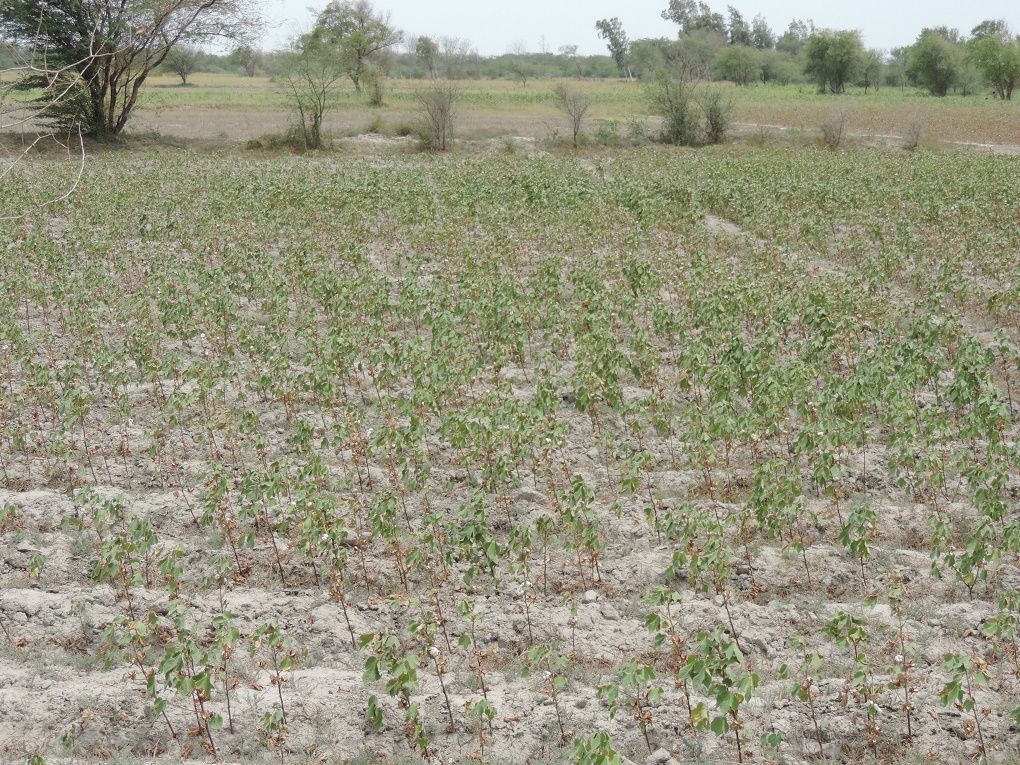
Sajan Sheikh owns a piece of land at the tail-end of Mirwah canal in district Badin in the coastal areas. According to him he faces two interrelated problems: most of the time the river water does not reach his land, what does reach is saline water from the sea. In the last decade or so much of the land has been rendered unproductive. “We are in extreme difficulty; we have protested in front of the irrigation officials but no avail,” Sheikh says helplessly.
There are several reasons for the unequal distribution of water in Sindh in which tail-end farmers are denied their due share of water. The political economy of water has contributed largely to the current state of water distribution. A few people own large tracts of land and have become powerful. Using their political clout, they have gradually taken control over the irrigation department, manipulating existing laws to divert more water towards their land through sanctioning direct outlets from canals which were not allowed long ago.
The topography also works towards the advantage of the farmers with lands near the head of the canals. They tamper with the outlets or pump out more water than they are allocated using lift machines. This often happens in collusion with people from the irrigation department. Interestingly, the cultivated command area on direct outlets has been increasing but they also receive water from distributaries, which means in most cases those farms are drawing water from two sources.
The hidden water economy
Political influence has weakened the irrigation department. The very department assigned to distribute water equitably is engaged in serving vested interests and earning through rent seeking. During my personal observation in Mirpurkhas district for five years in the late 1990s, in each cropping season farmers upstream tampered with the outlet with support of a darogha (a lower level irrigation official who monitors the distribution network) and were paying about PKR 25,000 (USD 240) per outlet. So, if a distributary has 20 outlets, the darogha was collecting about PKR 500,000 (USD 4,800) in one season and about a million Pakistani rupees (USD 9,600) in a year, a substantial sum in Pakistan.
This cash was over and above what such officials would receive in kind, including foodstuffs such as wheat and mangoes. Informal sources reveal that this hidden market for water has now increased to a charge of PKR 100,000 (USD 960) per season per outlet.
Yet another reason is increasing demand in comparison to supply of water, with many factors contributing to it. Whatever the reasons for the increase in demand, it leads to water theft and encourages hidden water markets. Farmers who can afford to, buy water from the informal market. Farmers at the head reaches of the canals use their topographical advantage to deploy all means, either legal or illegal, to meet their demand.
And still another factor contributing to the woes of tail-end farmers is the physical limitation of the system. Most of the irrigation infrastructure is ageing, and therefore needs more care and maintenance. But due to inadequate maintenance the system is unable to carry the required water and its distribution instruments such as head regulators have been damaged over the years.
A farmer’s experience
Karamullah Qazi, a farmer, recounts how his family is affected by this:
[The problems are caused by] heavy tampering upstream, political intervention in water distribution for water diversion and – more importantly – the unauthorised discharge to direct outlets [if the authorised amount is 2 cusecs, some farmers take 10 cusecs]. Our distributary Sangi Pharao, in district Badin, which off takes from Nasir Branch of Rohri canal, gets 2-3 feet water against six feet sanctioned and it does not reach the last five watercourses that are supposed to water 5,000 acres of land.
Our family owns 310 acres land on this distributary, out of which we only cultivated 14 acres of banana crop this year which is drying out as well. Earlier we were cultivating more than 50 acres of cotton and chilies crop as well. The situation started worsening from 2008; we protested in Karachi and also went to Islamabad but nothing really happened.
Rather than using water resources for shared prosperity, poverty alleviation with a progressive political vision, irrigation officials and influential people have devised a system to further inequality. Until these political issues are addressed, mere infrastructure will not solve the problems of the poor farmers of Sindh.