A black-faced spoonbill takes off from South Korea to migrate south for winter across the Yellow Sea. The rare bird holds a steady course for 500 km towards the Tiaozini wetlands on China’s Jiangsu coast. About 60 km away from his destination, he veers north after flying through two wind farms. After another 60 km, the bird encounters a third wind farm. The line on the tracker now becomes confused, as the bird circles back on himself, unsure of where to go. Ultimately, he gives up and sets course for the Korean breeding grounds he just left, where he will not survive the winter.
This tragic case from November 2021 appeared in a 2024 paper in the journal Ecology. Researchers had tracked the black-faced spoonbill, which in China is a Class I protected species, as part of assessing the effect of wind farms on Yellow Sea bird migrations. The wind farms it encountered lie on the world’s largest flyway for migratory birds – the East Asian–Australasian Flyway. Every year, 280 species of water bird and 510 of land bird use the route. Endangered species such as the black-faced spoonbill, spoon-billed sandpiper, red-crowned crane, oriental stork and Chinese merganser are all frequent flyers.
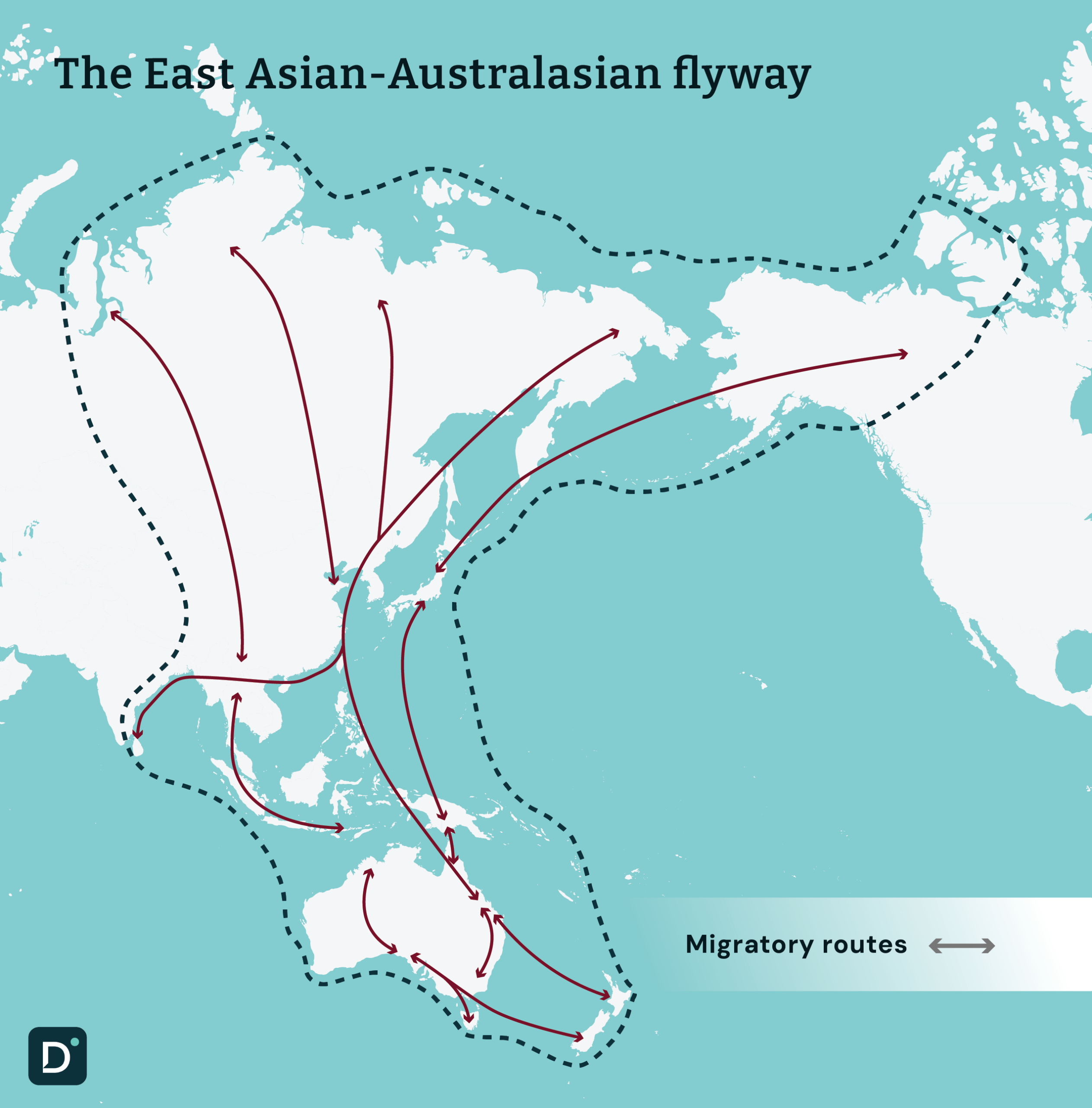
Something that needs to be talked about more is the impacts of wind farms on these birds. Almost all of China’s offshore and intertidal wind farms are on the East Asian–Australasian Flyway. They occupy a number of important resting points and other key locations. Elsewhere, wind farms in the East China Sea, Yellow Sea and Bohai Gulf sit on another called the West Pacific Flyway.
China is home to half of the world’s installed offshore wind power capacity, according to a recent report from Renewable UK. It currently has 114 offshore wind farms in operation and 87 key projects under construction. Many experts worry these facilities are a threat to migratory birds.
Reassessing the impact of coastal wind farms on birds is a task made more urgent by the issue of curtailment. As China’s solar and wind power capacity have soared, its electricity grids have been unable to absorb all the extra power, leading them to curtail – or waste – an increasing proportion. There is clearly a need to consider wind power projects and their positioning very carefully.
How to reduce the impact?
First we must note that climate change, window collisions and cats pose bigger risks to birds than do wind farms, which themselves have a crucial role to play in mitigating climate change.
Yet given that offshore wind farms pose a particular threat to ecologically important seabirds and birds of prey, how can their inevitable expansion be balanced with the need to protect biodiversity?
Terry Townshend is a British bird conservationist who has spent years working in China’s environmental sector. He says existing tools could be used to help site new wind farms where they impact birds less. These include Nature Conservancy India’s SiteRight tool, and BirdLife International’s AViStep, which uses spatial and geographic data to assess possible impacts.
Meteorological radar, designed to monitor metrics like humidity and wind speed, can also be used to provide real-time monitoring of birds in flight. That information could be used to stop turbines turning when large numbers of migratory birds are about to pass by – a tactic used successfully in Denmark, Germany and the Netherlands.
Cai Zhiyang, one of the authors of the black-faced spoonbill paper, thinks wind farms should also, where possible, avoid overlap with areas in which endangered species are active. He would like to see researchers work more closely with wind farm developers and policymakers, and suggests creating a platform making research data easily available “to avoid making unnecessary mistakes in site selection”.
Cai stressed the importance of ongoing monitoring. One aspect of this is gathering direct data, such as tracking the flights of migratory birds via satellite and recording their position, altitude and speed. Another is monitoring the benefits of mitigation measures, such as painting turbine blades to make them more visible.
When they are placed on land, Townshend suggests siting wind farms alongside existing infrastructure or on brownfield sites rather than taking up undeveloped land.
He would also like to see more communication between China and Europe, with sharing of experiences on how wind power relates to biodiversity, including existing best practices in site selection and mitigation of biodiversity risks. “Reducing the impact of wind power and other renewable-energy facilities on bird life allows us to better protect migratory birds, a part of our natural heritage which crosses regions and continents.”
The problem of collisions
Researchers have been studying the impacts of turbines on bird populations since the 1980s.
Wind farms tend to be built where winds are strong. Here, they may impact a variety of migratory birds, including endangered species and birds of prey. Large birds of prey use the wind to power their flight, meaning they are often found in these same areas and can be affected by turbines or killed in collisions.
Existing global research is concentrated on birds that migrate during the day. Observations, collision data, and even the black-faced spoonbill research mentioned above all tend to focus on daylight migrators. However, 80% of birds migrate at night, explains Townshend.
Another gap in the data is geographical. According to studies undertaken in Spain, the US and Australia, each offshore turbine could cause between four and 18 bird deaths a year. Data on what happens in China, though, is lacking.
Research from the British Trust for Ornithology, published in 2016, says “density-dependence” is key. When a population is large, losing a few individual birds will have little overall impact. But for smaller populations, even a few deaths can result in extinction.
Grey ‘unprotected’ zones
In any case, collisions may not be the biggest risk wind turbines present to migratory birds.
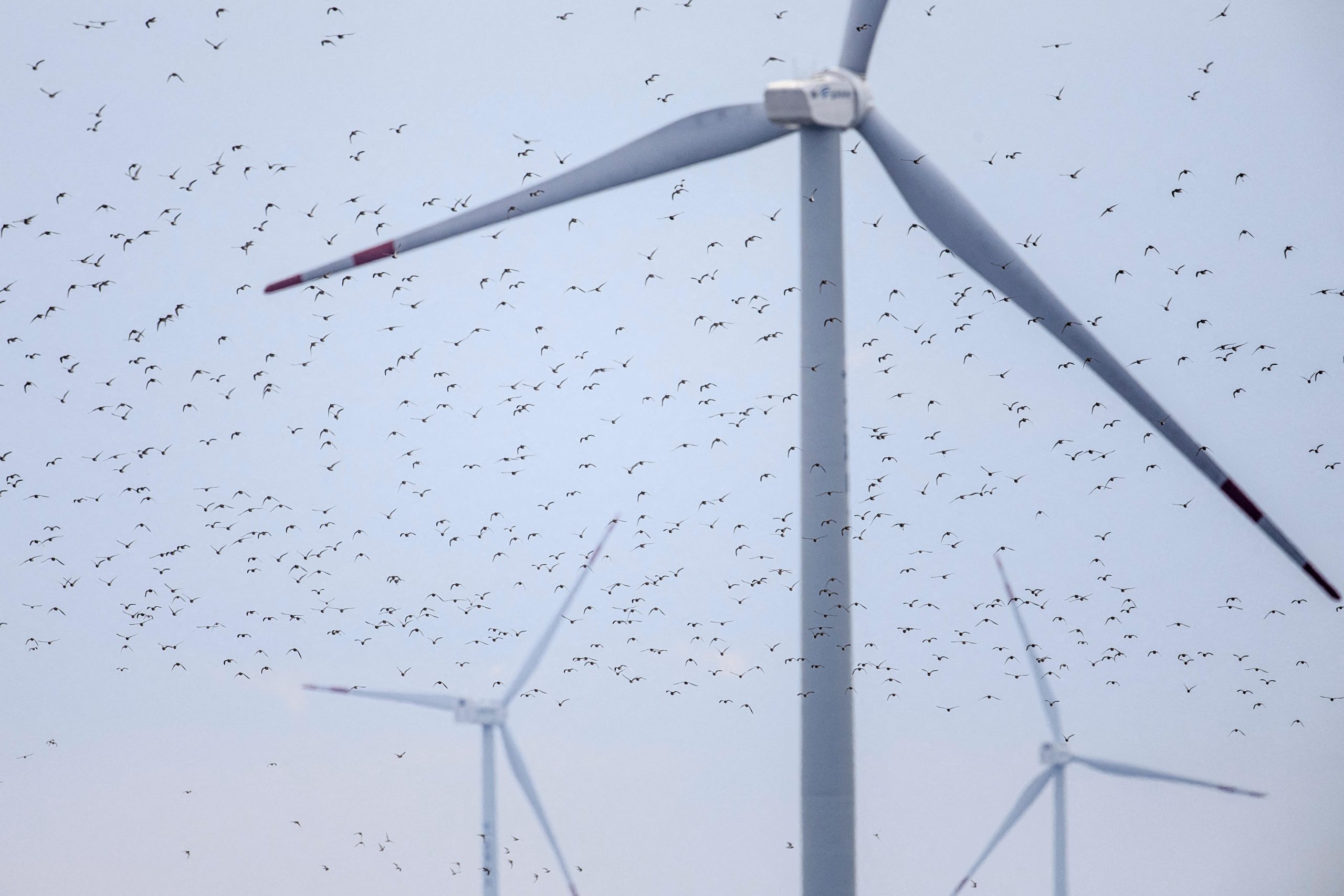
Birds generally have good eyesight and can spot and avoid obstacles, so they are likely to change course when approaching a wind farm. This is known as the “barrier effect”. However, it forces birds to take longer routes that use more energy, which means less success in breeding and less chance of surviving winter. The black-faced spoonbill near Tiaozini is a case in point.
A 2012 study also found an “occupation effect” – when wind farms are built where birds live or feed, causing a loss of biodiversity.
Biodiversity conservation shouldn’t be confined to protected areas, according to Townshend. Migratory birds pass through large amounts of unprotected territory, which is also important, he says.
Cai Zhiyang explains that some wind farms are built on tidal flats and wetlands that are vital for migratory birds. Developers sometimes put mitigation or compensatory measures in place, such as creating an alternative artificial wetland, “but the ecologies of those are often badly managed”. As a result, he says, those sites do not adequately compensate for the lost feeding opportunities.
Waders are both reliant on and loyal to particular habitats, points out a report from conservation organisation Spoon-Billed Sandpiper in China. If a habitat is lost, they may not easily transfer to another. The Yellow Sea and Bohai Gulf on China’s eastern coast are the country’s most important habitat for waders. But research has found one-third of shoals and wetlands there were lost between the mid-1990s and 2014. Wader numbers dropped by nearly 8% in the area over the same period.
Are impact assessments accurate?
By 2012, China’s National Energy Administration was requiring builders of wind farms affecting national reserves to consult with environmental authorities and carry out an environmental impact assessment. In 2022, the Ministry of Ecology and Environment issued technical guidelines for assessing ecological impact during such assessments. These required looking at a range of factors, including impact on wildlife migratory routes and biologically sensitive zones.
But as Cai Zhiyang points out, although those guidelines suggest avoiding bird migration routes, those routes are not clearly defined. This hampers implementation and leads companies to carry out simple surveys of bird species and numbers, and to estimate potential collision numbers by reference to overseas research.
A 2024 assessment for a wind farm in Yancheng, for example, stated that “over 80% of bird species can pass though variable speed wind turbines without suffering any harm. Therefore, in clear conditions, the chance of birds striking turbines is very low.”
But the term “very low” is a qualitative judgement, and the 80% figure comes from overseas research rather than long-term, quantitative studies on site.
Clearly there is much work to be done to ensure China’s wind power boom protects rare migratory birds rather than endangers them.