Mohammad Mushtaq recently paid a PKR 2,000 (USD 7.20) fine after his autorickshaw was stopped for emitting smoke in Punjab’s capital, Lahore. Repairing the petrol three-wheeler would cost PKR 12,000 (USD 43), so Mushtaq found another way to avoid fines: “It is only when I accelerate that smoke clouds appear and I can get caught by the police,” he says. “So, I ride on slow speed.”
Strictly speaking, autorickshaws are only a small part of the smog problem in Punjab, Pakistan’s richest and most populous province. According to the 2023 Sectoral Emission Inventory of Lahore produced by The Urban Unit, a private sector company wholly owned by the provincial government of Punjab, autorickshaws contribute just 4.24 gigagrams (Gg) of 153 Gg of emissions in the city – less than 3%. The larger problem is lax enforcement when it comes to the transport sector as a whole, which contributes 127.22 Gg (83%) to Lahore’s emissions.
The tech company IQAir ranked Lahore fifth on its index of the world’s most polluted cities between 2017 and 2023. It was precisely to tackle these big issues that the chief minister of Punjab, Maryam Nawaz, launched a roadmap for smog mitigation in early October. The announcement came at the start of smog season, which lasts until February.
This year, the pollution has been worse. In early November, as schools were forced to close and emergency measures were put in place, IQAir ranked Lahore as the most polluted city in the world.
Smog plan: Good on paper
The new roadmap claims to address the main sources of pollution for the province – transport, industry, energy, and agriculture, including the burning of crop residue – and sets monthly targets that must be met throughout the smog season. The departments of environmental protection, transport, agriculture, industry and health, as well as the Punjab Horticulture Authority, local governments and district commissioners, must all adhere to these targets.
To deal with industrial emissions, the plan orders factory owners to install pollution-control devices. There is also a dedicated helpline for smog-related complaints against individuals, companies, corporate bodies and industries. For smog-related health problems such as strokes, lung cancer and chronic pulmonary diseases, designated wards, smog counters and mobile health units are to be set up.
The plan also pledges to subsidise 5,000 environmentally friendly super seeders for farmers, with the government bearing 60% of the cost. A super seeder is a machine designed to drill wheat and fertiliser into fields covered in rice crop residues. Doing so eliminates the need to clear this residue, the burning of which adds to winter air pollution.
To deal with transport-related pollution, the roadmap includes stricter vehicular fitness checks. Any vehicle without a fitness certificate is now barred from plying the streets of Punjab.
Mixed reception
Dialogue Earth consulted Malik Amin Aslam, who served as Minister for Environment from 2002-2007, and an adviser on climate change to the prime minister from 2018-2022. He says much of the Punjab government’s plan is only a “repeat of the previous plans” that various governments, including his, had proposed.
Marriyum Aurangzeb, the Minister for Planning and Development, Environment Protection and Climate Change in Punjab, hits back. “Earlier governments focused on managing smog only when it intensified,” she tells Dialogue Earth. “We are working towards mitigating smog ahead of the winter months.
“We are revamping the Environment Protection Authority [EPA], setting up a 500-personnel strong environment protection squad and adding eight monitoring units in Lahore, and a robust legal framework will back the plan.”
Presently, there are five or six reference monitors in Punjab, not enough for a city the size of Lahore – leave alone the provinceAhmad Rafay Alam, environmental lawyer and climate expert
Looking back, Aslam says the biggest challenge in the past was the “lack of funding”. This time, however, Aurangzeb says the plan features a significantly larger and more targeted budget of PKR 10.23 billion (USD 36.76 million).
“This is a humongous sum of money,” concedes Aslam. “I just hope it is spent on concrete steps that are needed, like strengthening the air-monitoring systems, which provide critical data needed to pinpoint hotspots and manage traffic accordingly.”
Monitoring air quality
Ahmad Rafay Alam, a climate expert and one of Pakistan’s leading environmental lawyers, says that for the action plan to work effectively, Punjab needs a lot more air monitors to adequately study its quality and analyse the data.
“Presently, there are five or six reference monitors in Punjab, not enough for a city the size of Lahore – leave alone the province,” he tells Dialogue Earth.
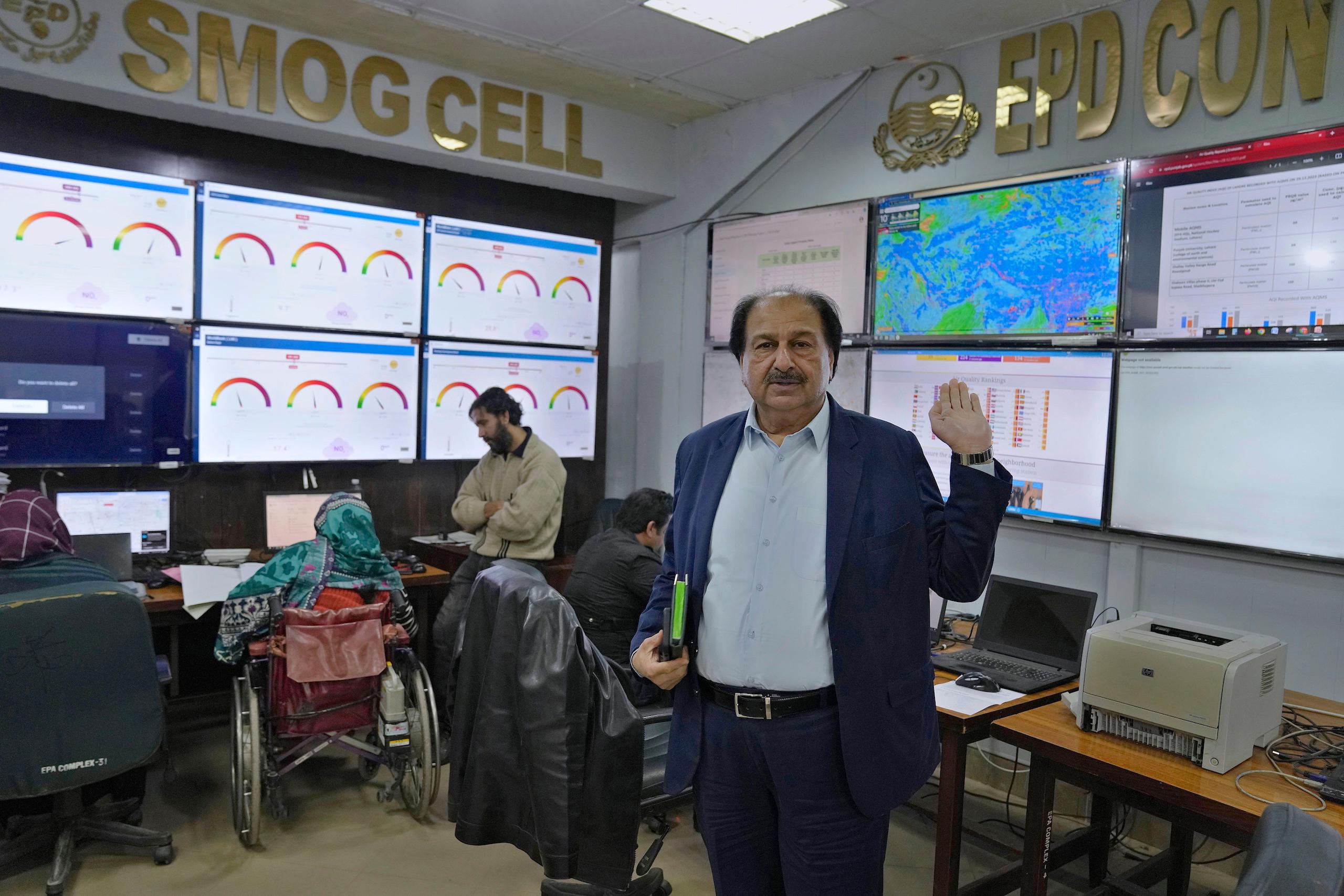
The Punjab government seems to be listening, and has announced plans to install another 30 “advanced” air-quality monitors across the province.
Osman Haq and Abdullah Mahmood of the Centre for Economic Research in Pakistan point out that the quality of air monitors is important. They tell Dialogue Earth that consumer-grade monitors typically have a range of only 20-30 metres, while industrial-grade sensors provide broader and more precise readings. They say accurate coverage data may help divide the province into smaller geographical units, allowing for more targeted action.
Poor implementation
Umair Javed, who teaches sociology at the Lahore University of Management Sciences, worries the plan may be undercut by “patchy implementation”, even if the data is improved.
Javed suggests that, rather than forcing polluting industries to change their behaviour, government institutions have instead developed “punitive” measures to target consumers, who have little political clout and are often the victims. “This explains why it’s easier to shut down schools and restaurants, but not polluting factories,” he adds.
The province’s failure to control vehicular emissions points to weaknesses in the enforcement of its policies, Javed suggests. Strategic steps, such as a ban on low-quality fuel, are also missing from the action plan. It was only when the level of air pollution became a “calamity” that steps to halt the use of low-quality fuel were put in place at the start of November.
Low-quality fuel – mostly Euro 2 and smuggled, high-sulphur high-speed diesel – has been a longstanding problem. Hammad Naqi, director general of WWF Pakistan, adds: “We’re using low-quality fuel that’s banned in many countries.”
Highlighting the challenges with strategy and implementation, an energy expert who requested not to be named tells Dialogue Earth that good-quality fuel is undermined by polluting vehicles: “Pakistan imports fuel oil that meets [the EU’s] Euro 5 standards, but it does not give desirable results in the absence of strict enforcement-of-fitness certificates meant for commercial vehicles.”
In another example of poor implementation and patchy infrastructure, there are only 32 vehicle-inspection stations in Punjab, which has a population of 127.7 million people and more than 24 million vehicles. Last year, “roughly 160,000 out of a total of 1.2 million public service vehicles such as buses, vans, autorickshaws [and] trucks registered with the Excise and Taxation Department” were inspected, according to a representative for the Transport and Mass Transit Department who requested not to be named.
According to Malik Amin Aslam, this tougher stance on vehicle inspections “will remain mere hot air adding to the smog” until mass-scale, “credible and transparent” checks are increased.
Marriyum Aurangzeb, though, remains undeterred: “If Beijing can turn the corner, so shall we.” She acknowledges, however, that it will not happen in a day, or even a year, and that the fight is a long one. “It may take 8-10 years.”