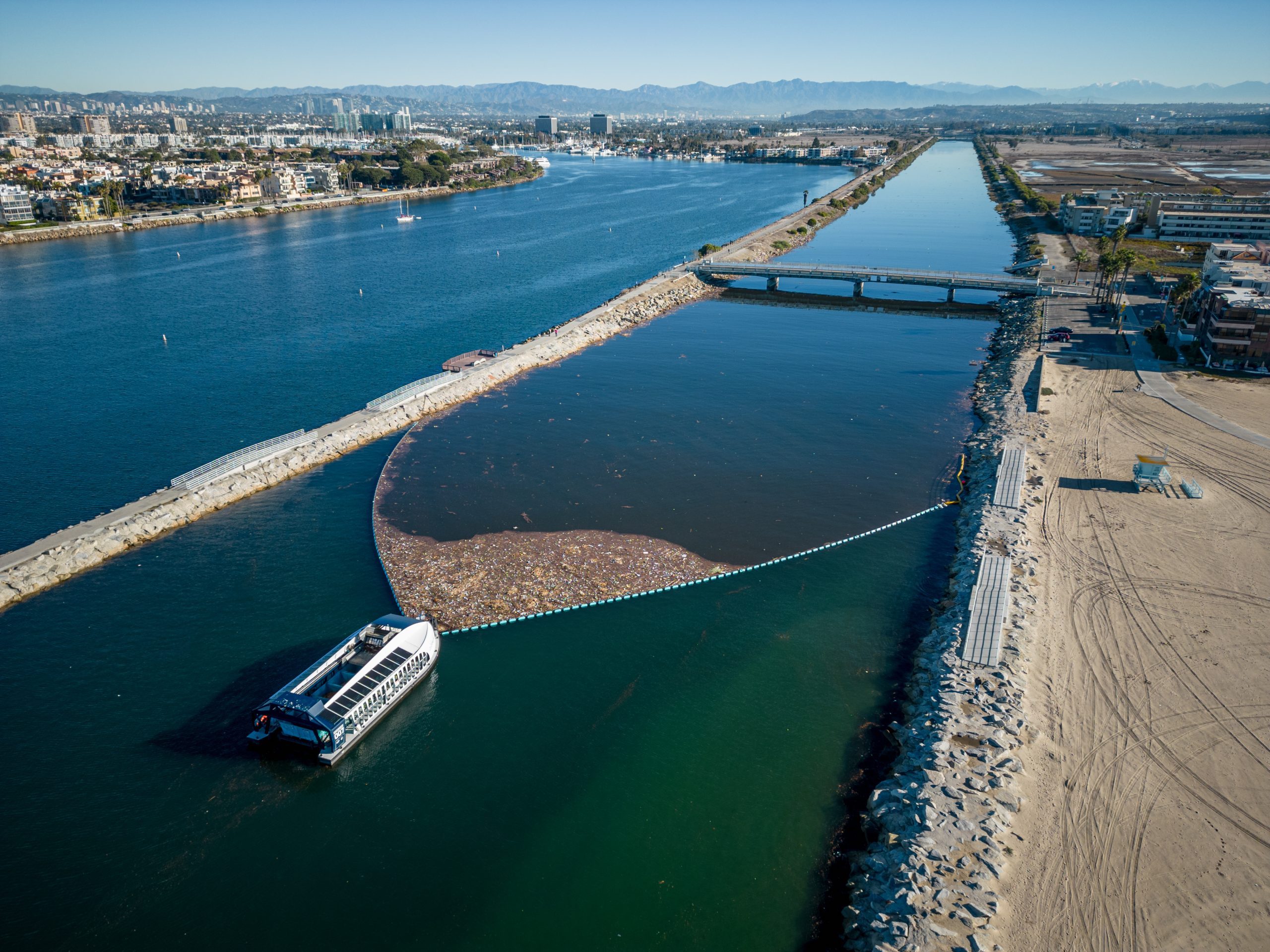
A curved boom, known as Interceptor 001, traps rubbish floating along a drainage canal in North Jakarta.
Discarded plastic bottles, food packaging and other debris are scooped up and moved along a conveyor belt into a boat. Once sorted, the plastics will be recycled.
The trial has been a success, triggering plans to deploy more Interceptors nationally.
The project is a partnership between the Indonesian and Dutch governments and Dutch non-profit the Ocean Cleanup.
It forms a small part of Indonesia’s mission, set in 2017, to reduce by 70% the amount of plastic entering the ocean from its coastline by 2025.
Expanding a successful pilot
After three years of trials, an announcement was made at last November’s G20 summit in Bali that Interceptors will be rolled out across Indonesia.
Lambert Grijns, Indonesian ambassador for the Netherlands, said in a press release: “Despite the scale of the plastic challenge, the endorsement of these innovative solutions and partnerships gives me hope that we can work together to finally solve this problem for the benefit of all.”
The first phase of the project was mainly aimed at collecting data, to aid river plastic waste solutions and waste management, explained M. Saleh Nugrahadi, deputy assistant of river management and natural resources conservation at Indonesia’s maritime ministry.
That data showed that 30 to 40% of river waste is plastic or non-organic, and that the volume of plastic fluctuates, with more trapped in the rainy season than in the dry.
“The waste collected will be a part of the circular economy. That way, it will no longer be an additional burden for the landfill,” Nugrahadi said.
The second phase
After assessing 100 of the most polluted rivers in Indonesia, the Ocean Cleanup has identified over 60 where they will deploy Interceptors in the second phase, the organisation told China Dialogue Ocean.
When selecting the rivers, they considered how much plastic flows from them into the ocean.
The smooth operation of the new Interceptors may depend on the cooperation of local fishers. The trial could run uninterrupted in Cengkareng drainage canal because there is no fishing there, Nugrahadi said. The operating team is considering how best to work with fishers to ensure both the plastic collecting work and fishing activities aren’t disrupted.
Tackling ocean plastic at source
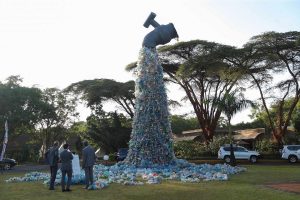
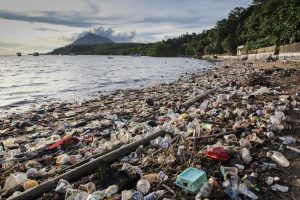
Close to two-thirds of rivers in Indonesia are heavily polluted, according to the environment ministry. The hard work of Interceptor 001 doesn’t only aim to deliver cleaner and plastic-free rivers for Indonesia, but ultimately to close the tap on ocean plastic pollution.
“Marine plastic debris is our common enemy,” said Luhut Binsar Pandjaitan, coordinating minister for maritime affairs and investment. “We require extraordinary and integrated solutions to responsibly manage the waste in the river and in the ocean.”
Eighty percent of riverine plastic pollution reaching the global ocean comes from 1,000 rivers. Most of these are small and flow through urban areas, according to a 2021 study.
Floating booms can cut plastic that ends up in the ocean by up to ten times, according to a study co-authored by Muhammad Reza Cordova, ocean chemical and ecotoxicology researcher at the National Research and Innovation Agency in Jakarta.
Cordova emphasised to China Dialogue Ocean, however, that to address the root causes means reducing plastic consumption and improving waste management.
In the long run the country needs to scale up its waste management infrastructure. A lack of rubbish bins, and of waste collections, contributes to people’s prevailing habit of littering, he added.
Global efforts needed
Worldwide, plastic production has doubled in two decades, from 234 million tonnes in 2000 to 460 million tonnes in 2019. To resolve a problem of such scale, we cannot rely only on voluntary national efforts like the Interceptor project.
In Cordova’s words: “This is a real threat, right in front of us, and it actually can be solved with quick and proper action. But this, of course, will need support from all stakeholders.”
Countries have increasingly recognised that stopping plastic pollution requires global governance and cooperation.
At the UN Environment Assembly last year, nations made a historic decision to establish a body to draft a legally binding agreement to end plastic pollution, including that which reaches the ocean. They set a 2024 deadline for finalising the agreement.
The first meeting of the body, known as the Intergovernmental Negotiating Committee (INC), took place in late November in Uruguay.
Cordova, who participated in the INC meeting virtually, said discussions included a potential ban on toxic chemical use in plastic production.
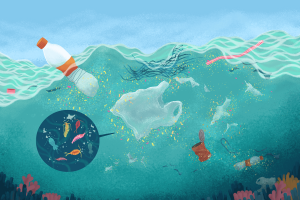
These chemicals often have far worse impacts than the plastic itself, Cordova said. For instance, Bisphenol A (BPA) or phthalates and its derivatives can stabilise the plastic structure, but disrupt the hormones of marine life, he said.