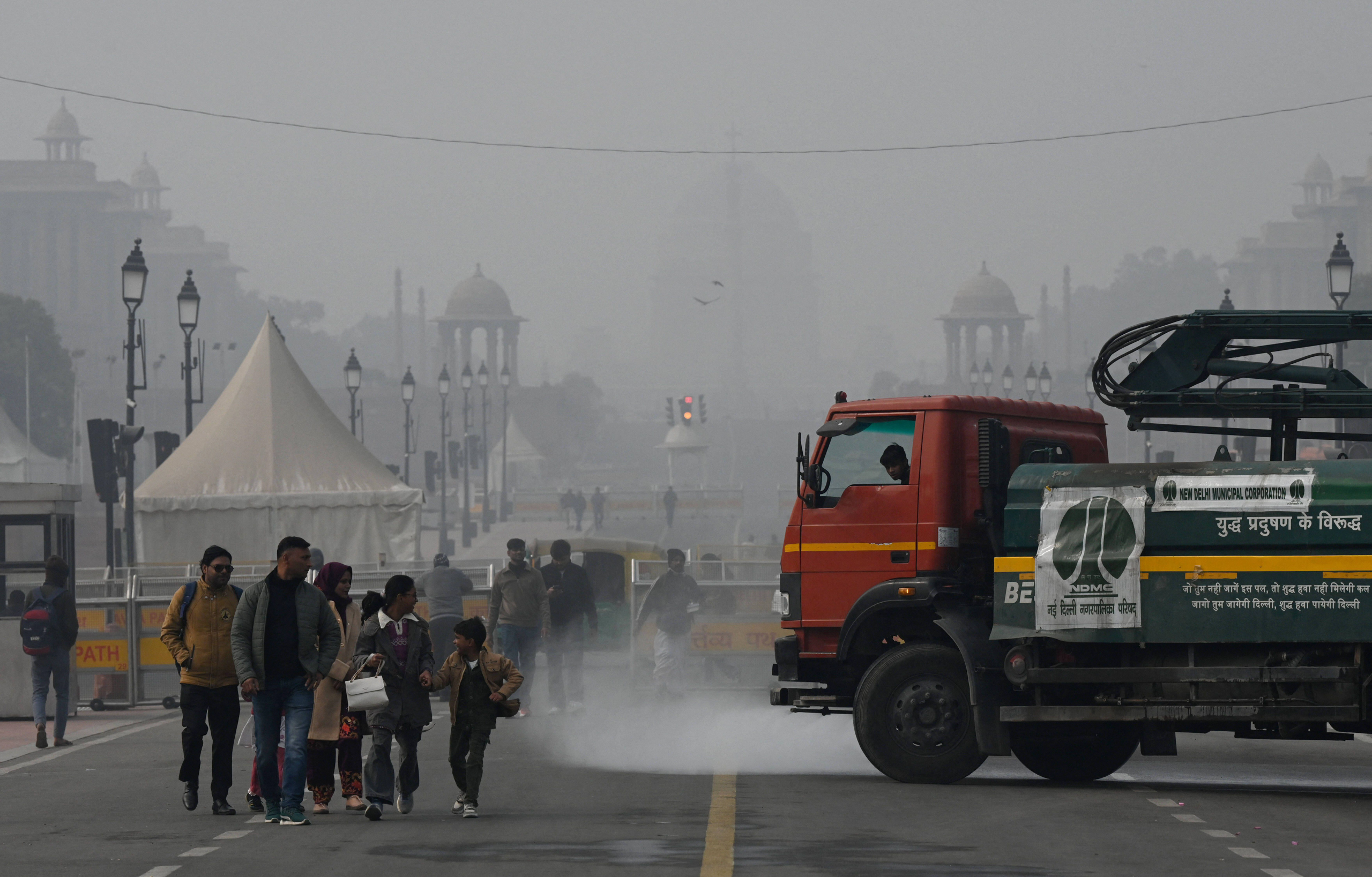
Every year, the cycle repeats itself. The temperature drops, but the air turns thick with smoke. India’s capital, Delhi, loses its sharpness – its colours and contrast. The sky turns grey, as people wheeze through their lives, left with little option but to feign normalcy. But the headlines scream another story – some say the city is “choking”, its air “unbreathable”, while others call it a “gas chamber”. A 2024 Lancet study argues that 12,000 deaths in the city can be attributed to air pollution annually, while an analysis by the Washington Post last month equates Delhi’s average daily air quality to smoking nine cigarettes a day.
This is winter in one of the world’s biggest cities, with a population upwards of 30 million. And yet, not everyone among those 30 million people experiences winter the same way.
It is early December in Okhla, a neighbourhood in south-east Delhi, and 49 year old Sunita Kumari walks to the construction site where she works as a labourer. This is the fourth day the sun has made no appearance – not because of clouds or rain, but due to the pollution that refuses to let it shine through. On the day Kumari spoke to Dialogue Earth, the air quality index (AQI) reading for Okhla on aqi.in, which collects data from private AQI meters installed across India, was 600. Most official AQI scales, such as those in India and the US, cap out at 500.
Her body heaves with a persistent, heavy cough that has bothered her for years. If she breathes deeply, she can feel her lungs ache. “It has been this way since I remember. So whatever damage [to health] will happen, we are well past that stage,” said Kumari, who was born and raised in the capital.
Delhi’s severe winter air pollution is attributable to a mix of geographical and local factors: crop-residue burning in neighbouring states, vehicular and industrial emissions, construction dust, waste burning and Diwali firecrackers. These factors are compounded by stagnant winds and temperature inversions that trap pollutants near the ground, creating a lethal cocktail that has led many to consider Delhi the most polluted capital in the world.
While pollution in the air is all pervasive, there are some who are finding ways to adapt – such as through the purchase of air purifiers. But for most lower-income Delhi residents, there are multiple exacerbating factors that make winter particularly harsh, and these must form the core of urban planning in the city, experts tell Dialogue Earth.
Street-level exposure
Gufran Beig is a meteorologist and the founder and former project director of System of Air Quality Forecasting and Research (Safar), an Indian government initiative that provides real-time, location-specific air quality information and forecasts for major Indian cities. With air pollution, he says, what matters when it comes to health deterioration is exposure: the pollution in the air one is in contact with.
Indoors, exposure can be reduced when homes and offices are fitted with multiple air purifiers that run continuously, with their filters regularly changed and users staying in rooms sealed to prevent air leakage.
But an air purifier is itself a luxury, as is the ability to stay home continually in a room – one that few can afford. In November, the Hindustan Times published a list of five air purifiers to survive Delhi’s worst AQI days with, at a cost of between INR 18,000 to INR 28,000 (USD 196-305). The nominal GDP per capita in India in 2024 was USD 2,700 a year.
The Delhi state government has faced criticism for reportedly purchasing air purifiers for its own offices, even as it struggles to design policy to combat air pollution.
Over 80% of Delhi’s workforce is comprised of informal workers, most of whom work outdoor jobs much like Kumari, according to a report from the labour research policy network Wiego. A 2023 report from environmental research NGO Chintan found that of 400 participants studied across three types of informal workers in Delhi, 97% of safai karamcharis (individuals involved in public sanitation work), 95% of wastepickers, and 82% of security guards reported exposure to air pollution while working.
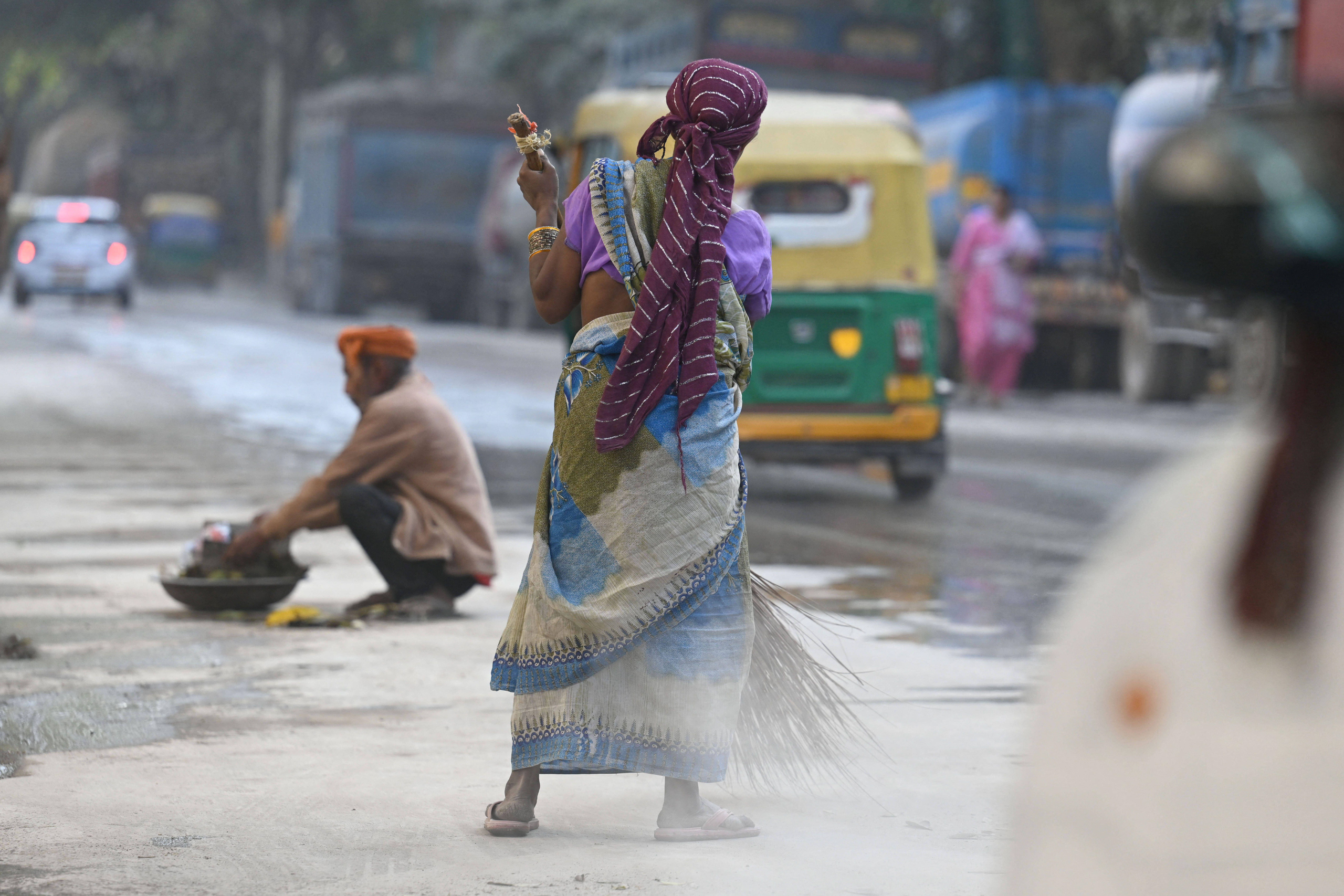
The Chintan report noted that between 30-60% of each group of workers were unaware that personal protective equipment (PPE) kits could reduce exposure, and nearly half of the wastepickers, 5% of safai karamcharis and 9% of security guards reported burning wood or coal for heat during winter. Abnormal pulmonary function results were recorded in 86% of safai karamcharis and security guards, as well as 75% of wastepickers. Women participants of all groups studied had poorer lung function than the men, it stated.
Not only do many lower-income Delhiites work outdoors, over 77% of the urban poor walk to work, noted the Delhi Development Authority in 2019, meaning they are more likely to inhale harmful pollutants. A 2015 study in Atmospheric Environment showed that walking on Delhi’s roads resulted in PM2.5 concentrations “exceed[ing] the ambient measurements by an average of 40%”. This was higher than non-active transport such as cars and auto-rickshaws due to lower travel speeds and higher inhalation rates, it stated. Meanwhile, for air-conditioned cars, concentrations were halved.
Women are particularly hard hit by these factors – a World Bank report estimated that 45% of women walk compared to 27% of men, often choosing this option for financial reasons.
Bhaumik Gowande, a researcher at the non-profit International Council on Clean Transportation, argues that these factors are exacerbated by local infrastructure in low-income neighbourhoods in the city like Okhla, where Kumari lives and works. In these built up former urban villages or peripheral regions, “you’ll find extremely dense cluster housing, where houses – a mix of high and low rises – develop in close proximity to each other. Some were illegal, some were later legalised,” he notes, “and the streets are so narrow that even a… minibus cannot pass through them”.
Instead, auto-rickshaws ply these streets. They pass close to homes in narrow cheek-by-jowl lanes, where most doors open directly onto the streets, Gowande says. Residents and commuters are constantly exposed to exhaust and tailpipe emissions from these vehicles, with a 2025 study showing that auto-rickshaw commuters had the highest level of PM2.5 emissions at 113 micrograms per cubic metre – nearly 40% higher than the next most exposed mode of vehicular transport, cars with their windows down.
Exposure at home
It isn’t just outdoors where pollution thrives in Delhi.
Experts told Dialogue Earth that the lived realities for the city’s lower income groups include added exposure to pollution inside their very homes.
“In slum areas where people use wood, charcoal, kerosene, or similar fuels [for cooking and heating], the exposure due to indoor air pollution is very high,” Beig said. These fuel sources release pollutants such as PM2.5, carbon monoxide and nitrogen dioxide within enclosed spaces – pollutants that are known to cause stroke, heart disease and lung cancer, amongst other deadly illnesses.
Here, too, women find themselves disproportionately affected, with responsibility for domestic duties largely on their shoulders. India’s 2024 national Time Use Survey stated that an average woman spends 289 minutes on unpaid domestic services for household members, including cooking – over three times that spent by men, at 88 minutes.
Identifying this as a problem, the Indian government launched a scheme in 2016 distributing liquefied petroleum gas (LPG) connections to women from families below the poverty line. But the use and refill of these cylinders remain low due to reasons including lack of affordability. “Families use LPG only for special occasions, such as weddings or social visits, while daily cooking continues with traditional fuels,” said Beig, who also teaches at the Indian Institute of Science in Bengaluru.
A 2021 study on the impact of pollution on people of different income levels in India showed that low-income households face the brunt of all pollution sources. “Not only do they suffer indoor air pollution from their own cooking, but they also face a disproportionate share of mortality risks from AAP [ambient air pollution], including from electricity generation and other industries to which their consumption contributes relatively little,” it noted.
Clearing the air
While India waits for both concerted policy changes that tackle pollution, and attitude shifts when it comes to low-income neighbourhoods, experts believe there are small urban planning fixes that could bring relief.
One method is the containment of construction dust by making high protective barriers, like those used at government construction sites, mandatory for all construction and demolition sites, says Shashwat Shukla, a research analyst who has worked at the UN Sustainable Development Solutions Network. Road dust can be reduced in low-income neighbourhoods by paving roads, so that walking commuters like Kumari face lower exposure, he added. According to a 2026 report from India’s Commission for Air Quality Management, these two sources of dust make up 15% of Delhi’s winter air pollution.
Gowande says that in low-income, high-density settlements, the lack of green buffers has led to pollutants lingering. Beig, Shukla and Gowande all note that green cover, such as trees and bushes, should be introduced along roads and medians where possible. In neighbourhoods where space is limited, planting trees on either sides of narrow streets make for good green buffers, Gowande says. Another idea, he proposes, is making some of them pedestrian-only.
None of this, Beig cautions, can be done without planning and forethought. He points to Safar’s air monitoring stations showing that even in the summer, ozone levels were high in some wealthy residential areas because trees that emit volatile organic compounds (VOCs) were planted there. Such VOCs can interact with gases emitted by vehicular exhaust to create ozone and fine particulate matter. “Traditional trees [such as neem, peepal, banyan] that people historically valued and protected tend to be better in this regard,” he says.
Back in Okhla on that December morning, Kumari was dismissive about the chances of change. For her, pollution has become a permanent fixture, her response almost fatalistic about the sun that refuses to rise, or the cough that refuses to go away. “Can’t outrun one’s fate,” she said. For Delhi, the challenge is not just to clear the air, but to make change begin where it is least expected.