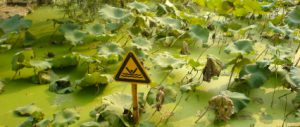
In a plastic-lined hole in a spit of sand stretching out into the Dead Sea, something is growing in the water.
Floating on top of the greenish pool – a mixture of 70% water from the Dead Sea and 30% water from the Red Sea – is a white scum of algae.
This is Pool No 9, dated March 2003. Next to it is Pool No 8, with exactly the same proportions of Dead Sea and Red Sea waters, created a year ago. Here the colour of the water is red.
No one knows why the two pools are different, but both environmentalists and industrialists are worried.
The reason behind the experimental mixing pools at the Dead Sea Works industrial complex, located at the southern end of the earth’s lowest point on land, is an ambitious and controversial proposal to build a conduit to pump water from the Red Sea to the Dead Sea in order to revitalise the latter’s shrinking dimensions.
It attracts hordes of tourists wanting to float in its waters and bathe in its restorative mud. But the level of the Dead Sea has dropped 25 metres in the past 50 years and it is continuing to recede at the rate of one metre a year.
North of the Dead Sea Works is Ein Gedi, a historic oasis where a luxury spa was originally built on the sea’s edge. Now, guests have to be transported one and a half kilometres to reach the sea. Further north, an abandoned restaurant, built on what was Lido Beach, is marooned inland. Where once the sea lapped almost at the feet of diners, there is now a vast expanse of rock and sand.
The gradual disappearance of the Dead Sea has alarmed environmentalists, industrialists and tourist authorities for years. It has been caused mainly by three countries – Israel, Jordan and Syria – diverting an astonishing 98% of its source, the once-surging Jordan river, to provide water for their citizens. (Another impact has been to deny much-needed water to Palestinian communities and businesses in the West Bank). Industry is also to blame: the waters of the Dead Sea have been pumped into evaporation ponds to allow the extraction of minerals.
Now the World Bank is conducting a study into the feasibility of taking water through tunnels, pipes and canals from the Red Sea to replenish the Dead Sea, and public hearings into the “Red-Dead Conduit” were held in June.
The plan, estimated to cost around US$15 billion, is enthusiastically backed by the Israeli and Jordanian governments. But both environmentalists and industry – usually in fierce opposition to one another – are deeply concerned about the consequences.
The Dead Sea Works, which extracts potash, bromine, magnesium and salt from the unique waters, has been experimentally mixing the seas for several years. It doesn’t like what it has seen.
“No one can answer for sure what the response of nature to the mixing will be,” Dr Joseph Lati, who is in charge of the experiment, says cautiously. “We have to go very carefully with this project until we know more about the biological and chemical effects. There might be micro-impacts that we don’t know about until they hit us.”
The red colour of Pool No 8 is due to the blooming of bacteria, he explains. The algae indicate that the mixing on a large scale would encourage the growth of living organisms in a sea with no life.
The World Bank study is considering a number of options, all of which involve massive construction in ecologically delicate areas of desert between the two seas. That in itself would be disruptive to biodiversity and costly, but the inclusion of two stretches of canal under one of the options would attract further development along their banks.
Both the Dead Sea Works and a coalition of environmentalists led by Friends of the Earth Middle East fear the study is being rushed and alternatives are not being properly considered.
The governments behind the plan are pushing the study towards “certain results”, contends Gidon Bromberg, Israeli director of Friends of the Earth Middle East (FoEME). “They are paying lip service to alternative options. The public consultations are a box-ticking exercise.”
The World Bank says nothing has been decided. “This is a big idea to address a big problem, namely the dying of the Dead Sea,” says the bank’s Alex McPhail. “We are still in the middle of a comprehensive and integrated evaluation of the proposed project.”
Bromberg is critical of the Dead Sea Works, despite its anxieties over the conduit scheme. “We have a common interest in not destroying the Dead Sea. But we know where our interests diverge.”
The company is only concerned with its commercial interests, he says, and whether a change in the chemical composition of Dead Sea waters would impact on its mineral extraction business – which has been a big contributor to the problem.
Bromberg says the conduit plan ignores the root cause of the dwindling Dead Sea. If Israel, Jordan and Syria halved the amount of water they diverted from the Jordan river, the Dead Sea would stabilise, he says. That would require ending the free supply of water to agriculture and asking some fundamental questions: “Do we need to grow bananas in the middle of the desert? Do we need to flush our toilets with clean drinking water?”
The Dead Sea will never completely disappear, says Bromberg. Fresh water continues to seep into the sea from the earth below it and, as the sea continues to drop, the rate of evaporation is slowing. “At some point the amount of water coming in will equal the evaporation,” says Bromberg, leading to the sea’s stabilisation. The solution, according to Noam Goldstein of Dead Sea Works, lies at the other end of the Dead Sea: “The best solution is for the Jordan river to flow again – this is what nature intended.”
Copyright © Guardian News and Media Ltd 2010
Homepage image by inju